
Protecting Clinical Momentum in an AI-Powered EHR

Research revealed that authentication workflows were interrupting the very efficiency gains an AI-assisted healthcare platform was designed to create.
ROLE
UX Research
& Digital Experience
Strategy Lead
OWNERSHIP
Authentication UX, Workflow Research, Strategy
Overview
AI Was Accelerating Documentation.
Access Was Slowing It Down.
Environment
Enterprise Healthcare Platform with AI-Assisted Clinical Documentation
Challenge
Authentication interruptions were disrupting documentation review, prescribing workflows, and clinician productivity.
Objective
Improve workflow continuity by redesigning authentication and recovery experiences without compromising security requirements.
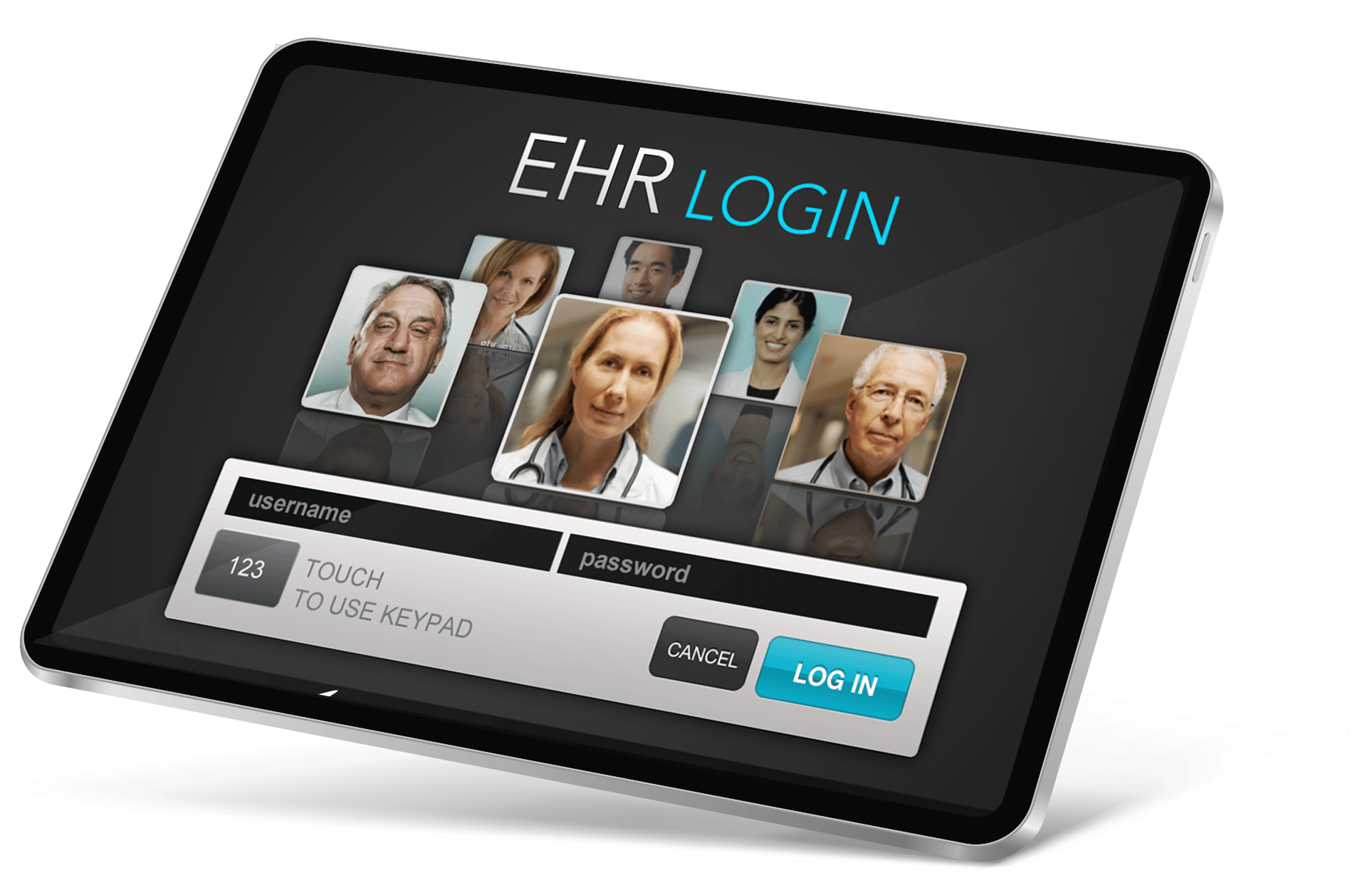
A healthcare technology company was expanding AI-assisted documentation capabilities designed to reduce administrative burden and help clinicians spend more time focused on patient care.
While the technology successfully accelerated documentation creation, research revealed that authentication and recovery workflows were introducing friction at critical moments in the clinical journey.
Login interruptions, session recovery, and repeated verification steps increased cognitive load, encouraged workarounds, and disrupted workflow continuity during time-sensitive clinical tasks.
A research-led initiative was launched to determine whether authentication design was limiting adoption, efficiency, and trust within the broader clinical workflow.
Research + Validation
The Data Explained What Clinicians Were Experiencing
To understand how authentication affected clinical workflows, I combined quantitative workflow analysis with qualitative behavioral research.
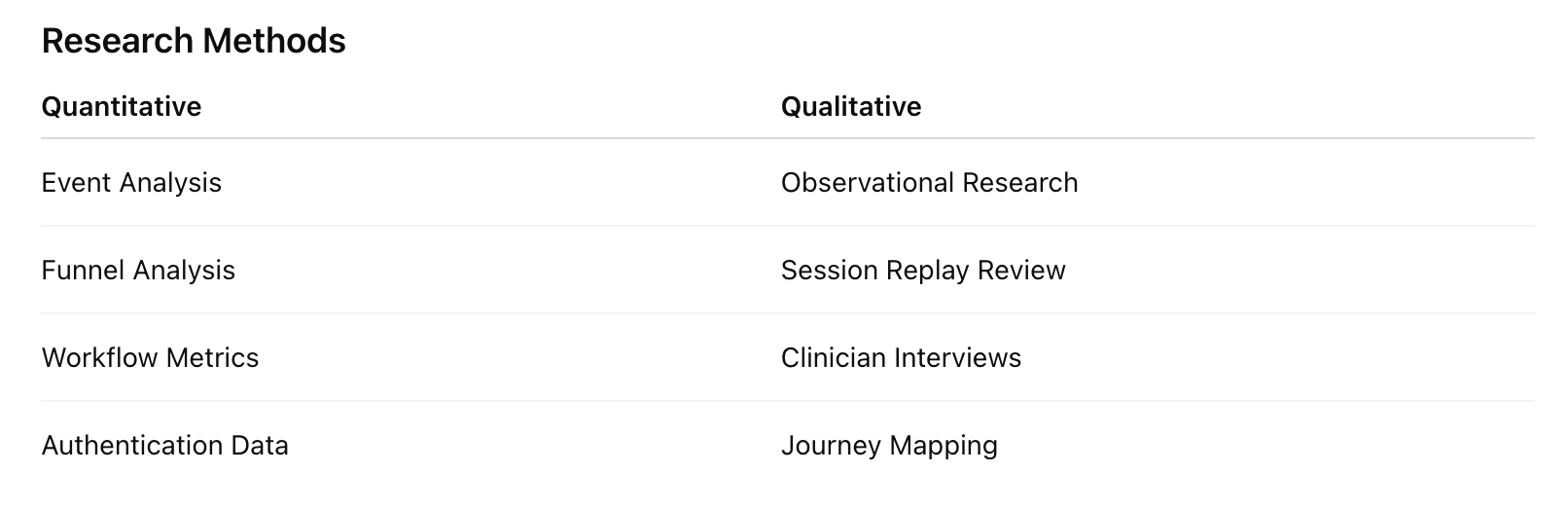
By analyzing both behavioral signals and workflow performance data, I was able to identify where clinicians encountered friction and understand how those interruptions influenced decision-making, trust, and task completion.
KEY INSIGHT 01
Authentication Was the Largest Point of Workflow Friction
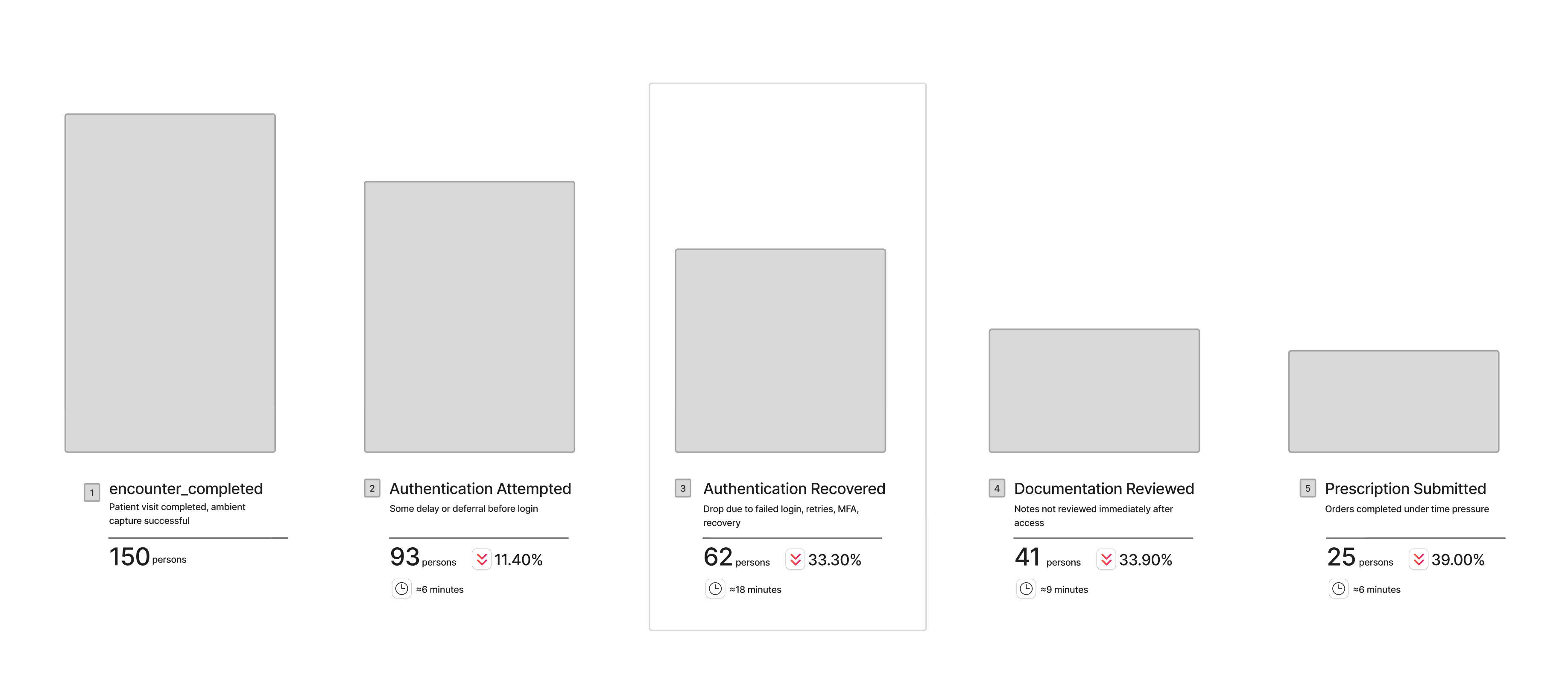
The workflow data revealed substantial attrition and delay after clinicians attempted to authenticate and regain access to the system.
What the data showed
- Authentication attempts introduced immediate workflow drop-off.
- Recovery workflows created the largest decrease in task completion.
- Documentation review and prescribing completion rates declined significantly after authentication interruptions.
- Time-to-completion increased as clinicians moved through recovery and verification steps.
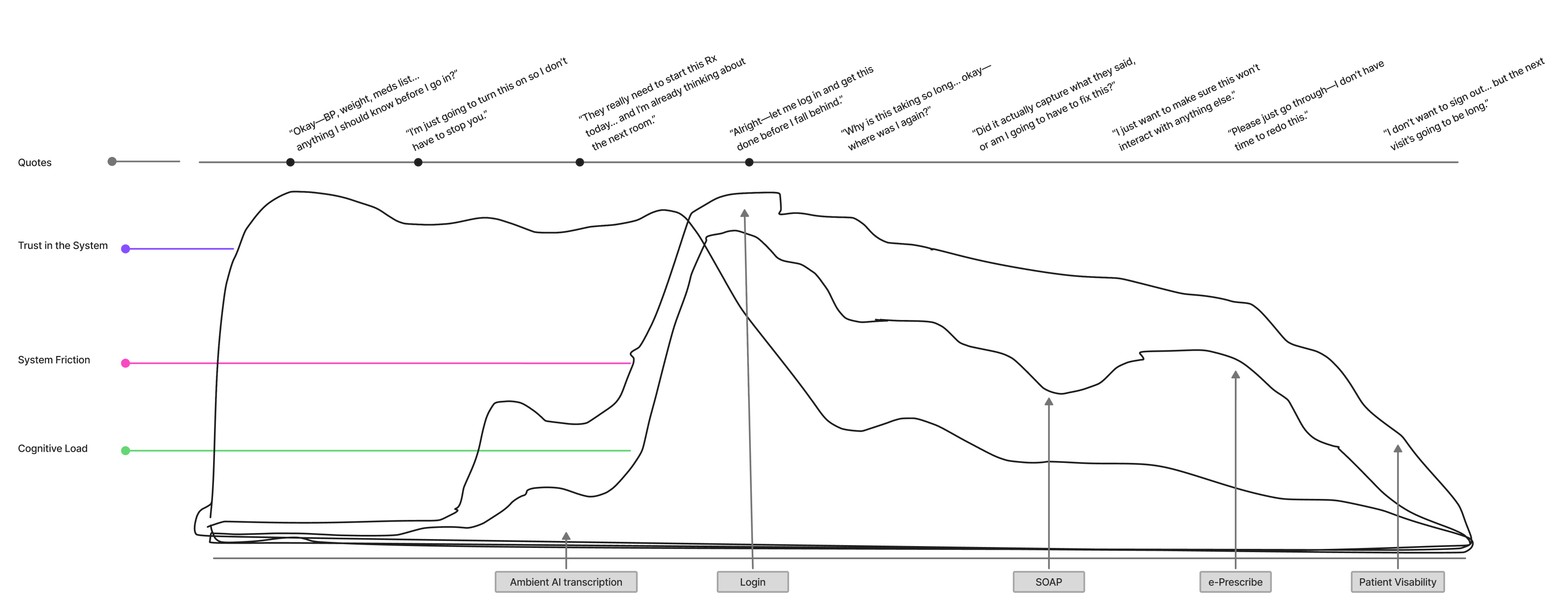
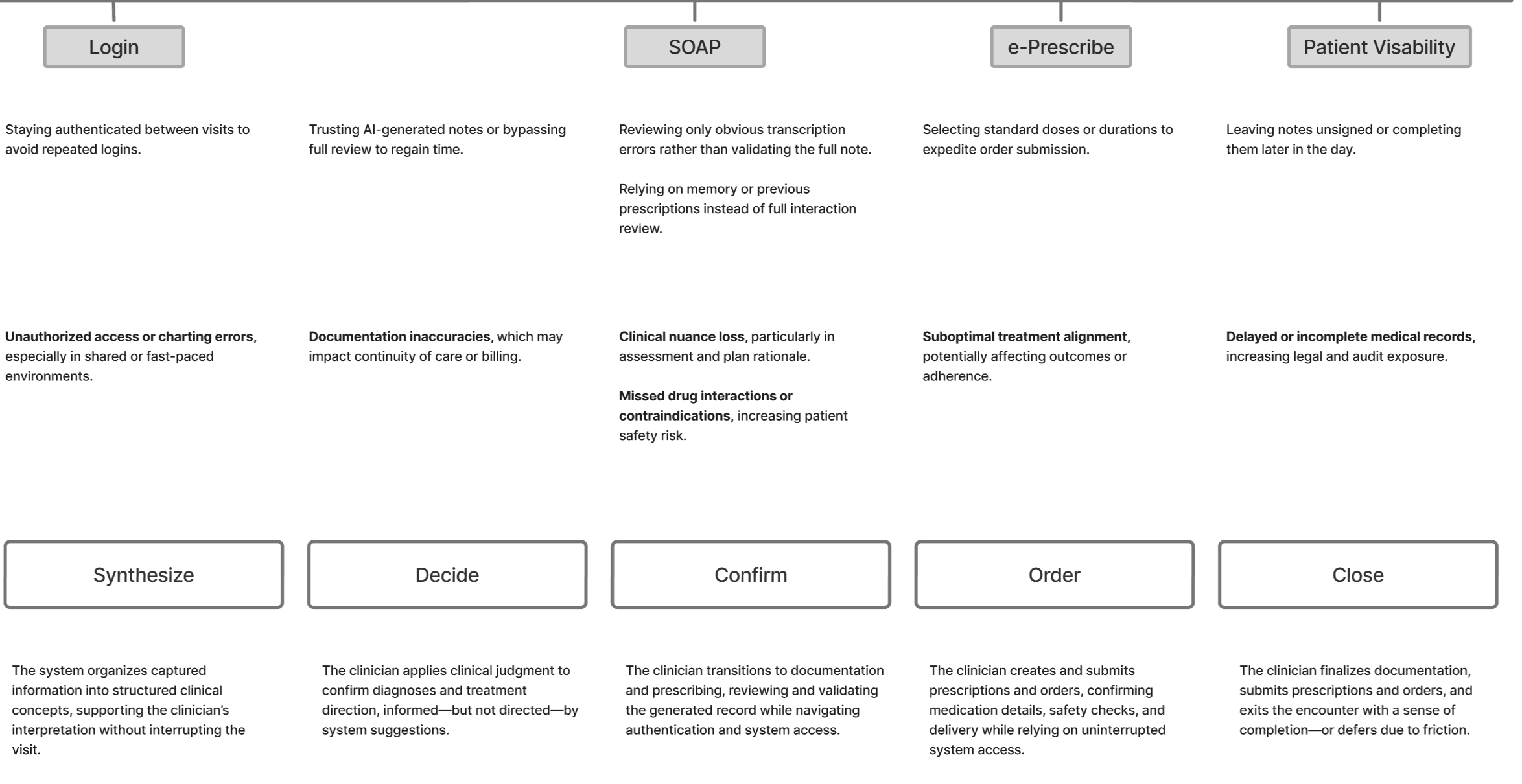
The funnel identified where clinicians were struggling. The journey map explained why.
KEY INSIGHT 02
Trust remained high until clinicians were forced to manage the system
Throughout patient conversations and AI-assisted documentation, clinicians reported feeling focused and confident.
That confidence shifted when authentication requirements interrupted the completion of clinical tasks.
Observation: Clinicians were focused on patient outcomes and workflow completion, not system interactions.
KEY INSIGHT 03
Login Friction Reduced Confidence in AI-Generated Documentation
The journey map revealed that authentication interruptions affected more than access—they changed how clinicians interacted with AI-generated information throughout the remainder of the workflow.
After regaining access, clinicians were more likely to prioritize task completion over validation. As they progressed through documentation review, prescribing, and encounter completion, confidence in the system began to erode.
"Did it actually capture what they said, or am I going to have to fix this?"
Concept Testing
Three Authentication Models Were Evaluated
To validate the research findings and identify a lower-friction approach, I developed and tested three authentication models with users. The objective was to understand how different verification strategies affected perceived effort, recovery confidence, and workflow continuity.
OPTION A
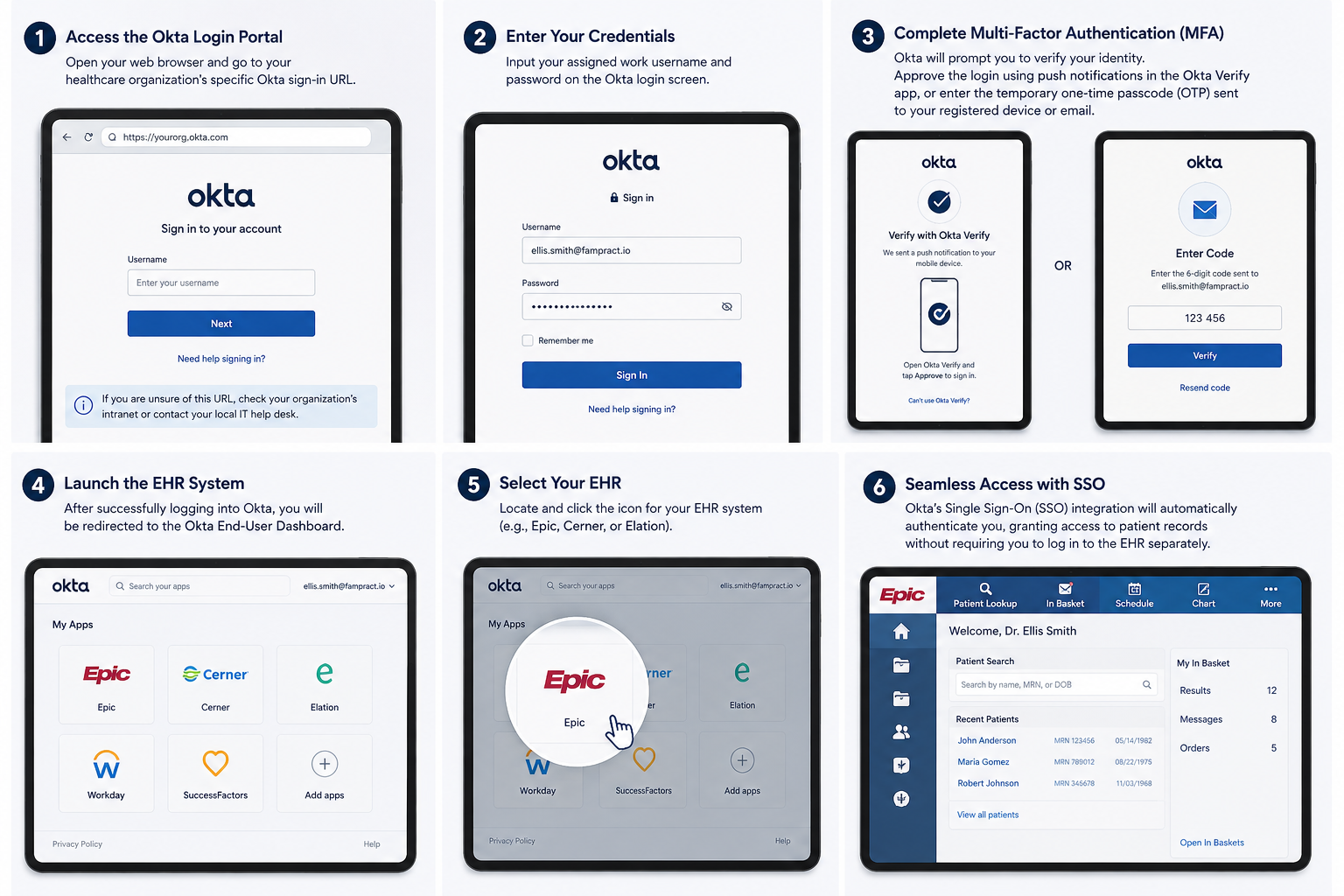
Traditional 2FA
Secure, but disruptive
Users understood the security benefits but consistently reported frustration with the number of required steps and recovery complexity.
“I don’t understand, am I logging in to Okta or our EHR. This is very confusing, and takes way to long.”
OPTION B
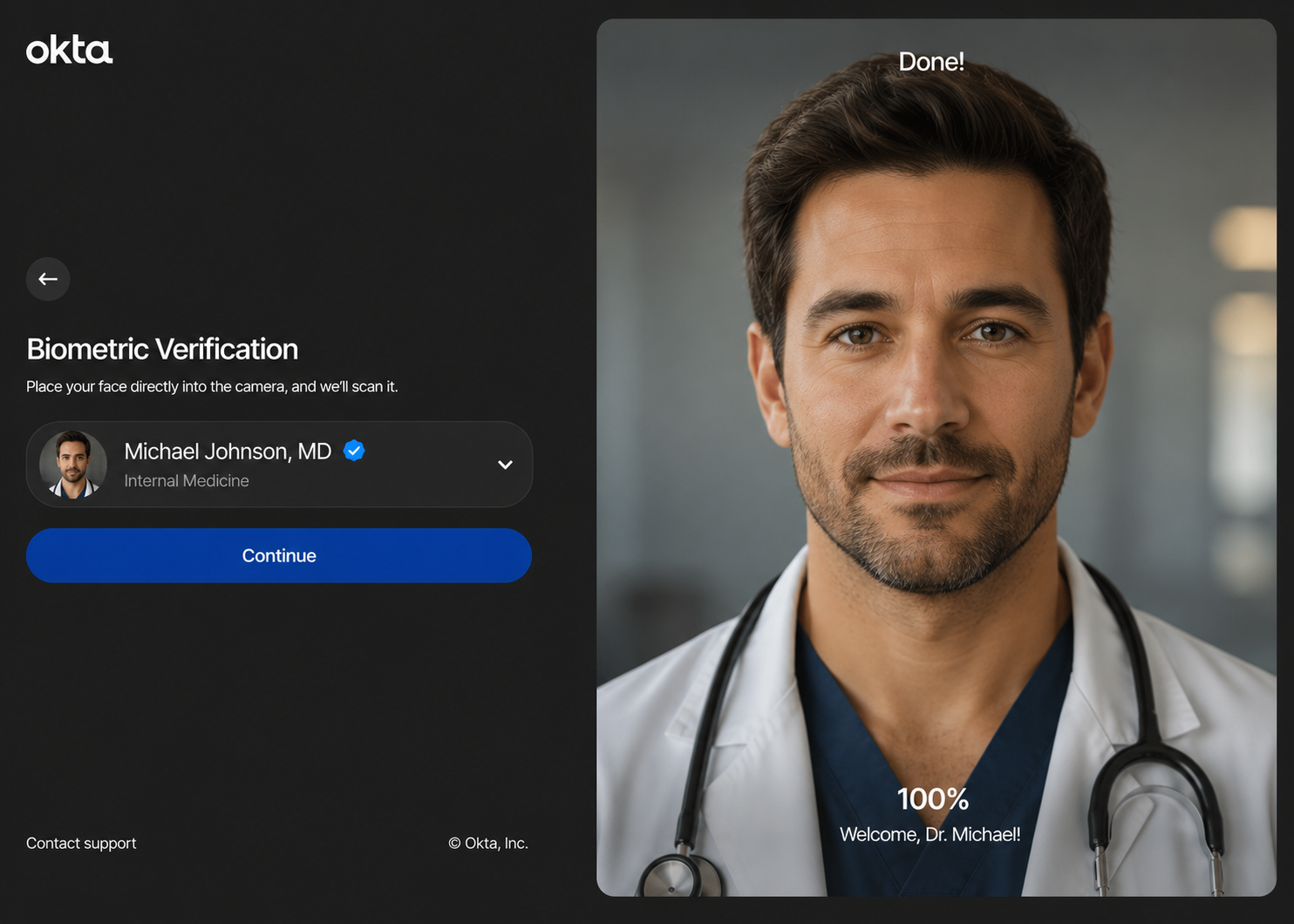
Biometric Only
Fast, but fragile
Participants appreciated the speed of biometric verification, but concerns emerged around recovery, device changes, and authentication failures.
“This is just like my phone, is that allowed for health records?
OPTION C
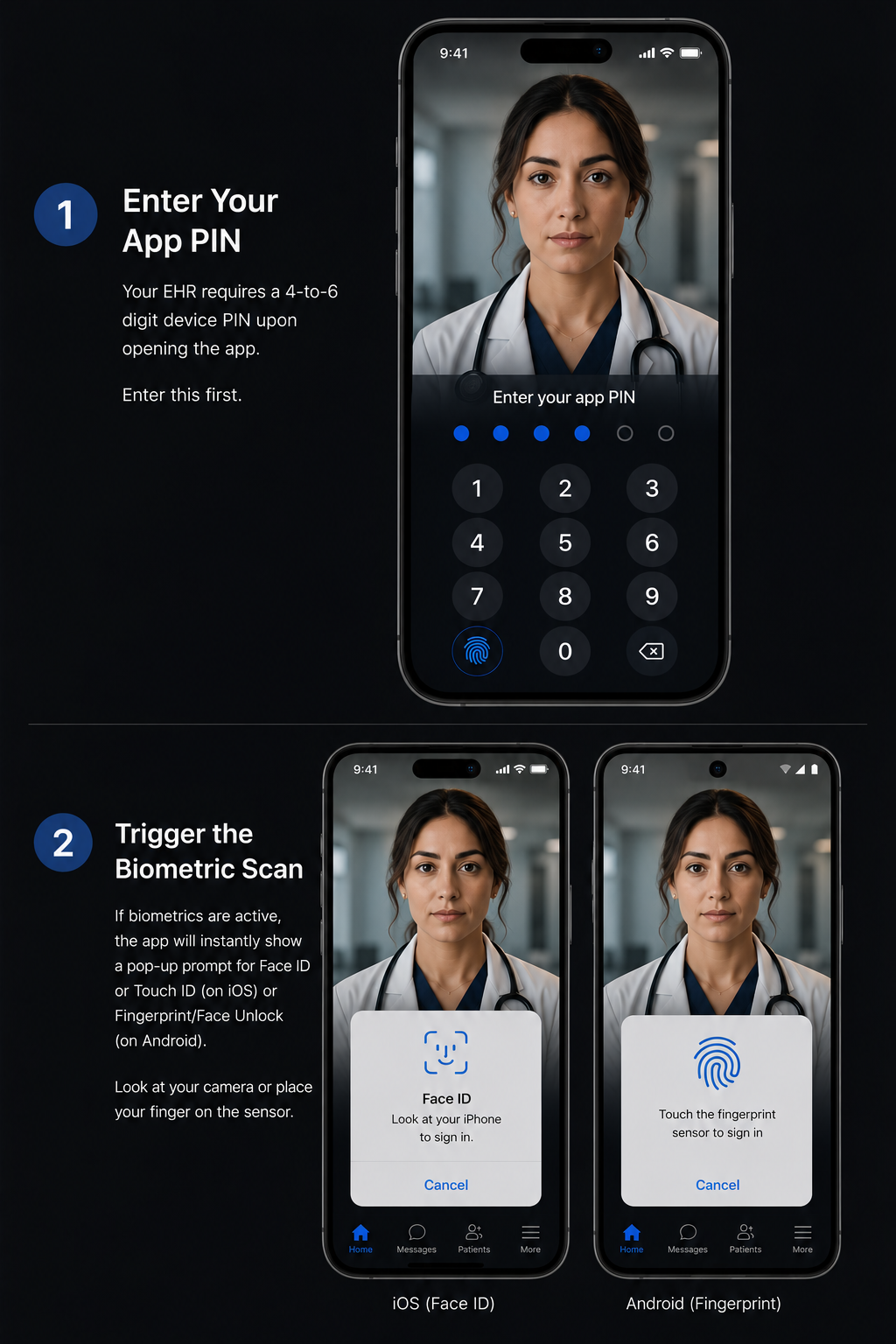
Hybrid Authentication
Balanced security and workflow continuity
The hybrid model combined biometric verification with clear fallback recovery paths.
Participants reported higher confidence, lower perceived effort, and greater trust in their ability to regain access without disrupting their workflow.
“Giving me the option to just sign-in with a pin makes this way easier”
Strategic Outcome
Research Translated Into a Lower-Friction Authentication Strategy
Rather than adding more security prompts, the strategy simplified the access experience around the moments clinicians were most likely to lose momentum. Identity selection happened before verification. Biometric authentication became the primary path. Password fallback remained available, but secondary. Post-login confirmation helped clinicians re-enter the workflow with confidence.
The result was a workflow strategy designed to protect clinical momentum while maintaining appropriate identity assurance.
The solution didn’t remove security. It redesigned access around the realities of clinical work.
Case Studies
FinTech • B2B SaaS • DX Strategy • Acquisition

A Strong Product. The Wrong Customers.
Building Around the Right Customer Changed Everything.
Behavioral analysis uncovered which customers actually drove revenue reshaping acquisition, onboarding, and growth strategy around their needs →
↑ 250% Organic Acquisition • ↑ 78% High-Value Accounts • ↓ 70% CPL
Higher Ed • Enrollment Strategy • Acquisition

Enrollment Friction Was Limiting Growth
Students Couldn't Find What They Needed to Believe
Organic traffic had successfully scaled, but lead generation performance had plateaued. Behavioral research uncovered gaps that traditional CRO metrics alone couldn't explain →
↑ Strategic Clarity • ↑ Customer Understanding • ↑ Growth Alignment
Pharma • Product Design • Retention

Improving Adoption Through Behavioral Design
Designing Around the Right Support System Changed Everything
Behavioral research, experience redesign, and coordinated support workflows helped users understand what mattered, what to do next, and when intervention was needed →
↑ Onboarding Completion • ↑ 7-Day Retention • ↓ Response Time
My Expertise Delivers For:
Marketing & Growth
Customer Acquisition & Conversion
Journey Mapping & Funnel Optimization
CRM & Retention Strategy
Behavioral Segmentation & Personalization
Landing Page & Onboarding Optimization
Customer Research & Insight Generation
AI-Supported Content & Experience Strategy
Product & CX
UX & Digital Experience Strategy
Onboarding & Adoption Systems
DAP Strategy & Optimization
Service Blueprinting
Customer & Employee Experience
Behavioral Design & Usability Optimization
AI-supported Product & Support Experiences
Strategy & Transformation
Cross-functional Alignment
Experience Transformation Initiatives
Operational Experience Design
Customer Intelligence Systems
Support and Onboarding Optimization
Research-driven Decision-making
AI-supported Workflow and Systems Strategy
Let’s Build Better Systems for People

© 2026 Beth Pavinich. All rights reserved.
All content, case studies, strategy frameworks, written materials, visuals, diagrams, concepts, and supporting artifacts featured on this site are the intellectual property of Beth Pavinich and may not be copied, reproduced, distributed, modified, adapted, republished, or used in whole or in part without prior written permission.
Many projects featured on this site were completed under non-disclosure agreements (NDAs). Client names and proprietary details have been anonymized. Outcomes reflect engagement-specific performance data, client reporting, benchmark analysis, and directional business impact estimates where exact figures cannot be disclosed.

Protecting Clinical Momentum in an AI-Powered EHR
Research revealed that authentication workflows were interrupting the very efficiency gains an AI-assisted healthcare platform was designed to create.
ROLE
UX Research
& Digital Experience
Strategy Lead
OWNERSHIP
Authentication UX, Workflow Research, Strategy
///
///
Overview
AI Was Accelerating Documentation.
Access Was Slowing It Down.
Environment
Enterprise Healthcare Platform with AI-Assisted Clinical Documentation
Challenge
Authentication interruptions were disrupting documentation review, prescribing workflows, and clinician productivity.
Objective
Improve workflow continuity by redesigning authentication and recovery experiences without compromising security requirements.
A healthcare technology company was expanding AI-assisted documentation capabilities designed to reduce administrative burden and help clinicians spend more time focused on patient care.
While the technology successfully accelerated documentation creation, research revealed that authentication and recovery workflows were introducing friction at critical moments in the clinical journey.
Login interruptions, session recovery, and repeated verification steps increased cognitive load, encouraged workarounds, and disrupted workflow continuity during time-sensitive clinical tasks.
A research-led initiative was launched to determine whether authentication design was limiting adoption, efficiency, and trust within the broader clinical workflow.
Research + Validation
The Data Explained What Clinicians Were Experiencing
To understand how authentication affected clinical workflows, I combined quantitative workflow analysis with qualitative behavioral research.
By analyzing both behavioral signals and workflow performance data, I was able to identify where clinicians encountered friction and understand how those interruptions influenced decision-making, trust, and task completion.
KEY INSIGHT 01
Authentication Was the Largest Point of Workflow Friction
The workflow data revealed substantial attrition and delay after clinicians attempted to authenticate and regain access to the system.
What the data showed
- Authentication attempts introduced immediate workflow drop-off.
- Recovery workflows created the largest decrease in task completion.
- Documentation review and prescribing completion rates declined significantly after authentication interruptions.
- Time-to-completion increased as clinicians moved through recovery and verification steps.
The funnel identified where clinicians were struggling. The journey map explained why.
KEY INSIGHT 02
Trust remained high until clinicians were forced to manage the system
Throughout patient conversations and AI-assisted documentation, clinicians reported feeling focused and confident.
That confidence shifted when authentication requirements interrupted the completion of clinical tasks.
Observation: Clinicians were focused on patient outcomes and workflow completion, not system interactions.
KEY INSIGHT 03
Login Friction Reduced Confidence in AI-Generated Documentation
The journey map revealed that authentication interruptions affected more than access—they changed how clinicians interacted with AI-generated information throughout the remainder of the workflow.
After regaining access, clinicians were more likely to prioritize task completion over validation. As they progressed through documentation review, prescribing, and encounter completion, confidence in the system began to erode.
"Did it actually capture what they said, or am I going to have to fix this?"
Concept Testing
Three Authentication Models Were Evaluated
To validate the research findings and identify a lower-friction approach, I developed and tested three authentication models with users. The objective was to understand how different verification strategies affected perceived effort, recovery confidence, and workflow continuity.
OPTION A
Traditional 2FA
Secure, but disruptive
Users understood the security benefits but consistently reported frustration with the number of required steps and recovery complexity.
“I don’t understand, am I logging in to Okta or our EHR. This is very confusing, and takes way to long.”
Option B
Biometric Only
Fast, but fragile
Participants appreciated the speed of biometric verification, but concerns emerged around recovery, device changes, and authentication failures.
“This is just like my phone, is that allowed for health records?
OPTION C
Hybrid Authentication
Balanced security and workflow continuity
The hybrid model combined biometric verification with clear fallback recovery paths.
Participants reported higher confidence, lower perceived effort, and greater trust in their ability to regain access without disrupting their workflow.
“Giving me the option to just sign-in with a pin makes this way easier”
Strategic Outcome
Research Translated Into a Lower-Friction Authentication Strategy
Rather than adding more security prompts, the strategy simplified the access experience around the moments clinicians were most likely to lose momentum. Identity selection happened before verification. Biometric authentication became the primary path. Password fallback remained available, but secondary. Post-login confirmation helped clinicians re-enter the workflow with confidence.
The result was a workflow strategy designed to protect clinical momentum while maintaining appropriate identity assurance.
The solution didn’t remove security. It redesigned access around the realities of clinical work.
Case Studies
A Strong Product. The Wrong Customers.
Building Around the Right Customer Changed Everything.
Behavioral analysis uncovered which customers actually drove revenue reshaping acquisition, onboarding, and growth strategy around their needs →
↑ 250% Organic Acquisition • ↑ 78% High-Value Accounts • ↓ 70% CPL

FinTech • B2B SaaS • DX Strategy • Acquisition
Enrollment Friction Was Limiting Growth
Students Couldn't Find What They Needed to Believe
Organic traffic had successfully scaled, but lead generation performance had plateaued. Behavioral research uncovered gaps that traditional CRO metrics alone couldn't explain →
↑ Strategic Clarity • ↑ Customer Understanding • ↑ Growth Alignment
Higher Ed • Enrollment Strategy • Acquisition
Improving Adoption Through Behavioral Design
Designing Around the Right Support System Changed Everything
Behavioral research, experience redesign, and coordinated support workflows helped users understand what mattered, what to do next, and when intervention was needed →
↑ Onboarding Completion • ↑ 7-Day Retention • ↓ Response Time
Pharma • Product Design • Retention
My Expertise Delivers For:
Marketing & Growth
Customer Acquisition & Conversion
Journey Mapping & Funnel Optimization
CRM & Retention Strategy
Behavioral Segmentation & Personalization
Landing Page & Onboarding Optimization
Customer Research & Insight Generation
AI-Supported Content & Experience Strategy
Product & CX
UX & Digital Experience Strategy
Onboarding & Adoption Systems
DAP Strategy & Optimization
Service Blueprinting
Customer & Employee Experience
Behavioral Design & Usability Optimization
AI-supported Product & Support Experiences
Strategy & Transformation
Cross-functional Alignment
Experience Transformation Initiatives
Operational Experience Design
Customer Intelligence Systems
Support and Onboarding Optimization
Research-driven Decision-making
AI-supported Workflow and Systems Strategy
Let’s Build Better Systems for People
© 2026 Beth Pavinich. All rights reserved.
All content, case studies, strategy frameworks, written materials, visuals, diagrams, concepts, and supporting artifacts featured on this site are the intellectual property of Beth Pavinich and may not be copied, reproduced, distributed, modified, adapted, republished, or used in whole or in part without prior written permission.
Many projects featured on this site were completed under non-disclosure agreements (NDAs). Client names and proprietary details have been anonymized. Outcomes reflect engagement-specific performance data, client reporting, benchmark analysis, and directional business impact estimates where exact figures cannot be disclosed.

Protecting Clinical Momentum in an AI-Powered EHR
Research revealed that authentication workflows were interrupting the very efficiency gains an AI-assisted healthcare platform was designed to create.
ROLE
UX Research
& Digital Experience
Strategy Lead
OWNERSHIP
Authentication UX, Workflow Research, Strategy
///
///
Overview
AI Was Accelerating Documentation.
Access Was Slowing It Down.
Environment
Enterprise Healthcare Platform with AI-Assisted Clinical Documentation
Challenge
Authentication interruptions were disrupting documentation review, prescribing workflows, and clinician productivity.
Objective
Improve workflow continuity by redesigning authentication and recovery experiences without compromising security requirements.
A healthcare technology company was expanding AI-assisted documentation capabilities designed to reduce administrative burden and help clinicians spend more time focused on patient care.
While the technology successfully accelerated documentation creation, research revealed that authentication and recovery workflows were introducing friction at critical moments in the clinical journey.
Login interruptions, session recovery, and repeated verification steps increased cognitive load, encouraged workarounds, and disrupted workflow continuity during time-sensitive clinical tasks.
A research-led initiative was launched to determine whether authentication design was limiting adoption, efficiency, and trust within the broader clinical workflow.
Research + Validation
The Data Explained What Clinicians Were Experiencing
To understand how authentication affected clinical workflows, I combined quantitative workflow analysis with qualitative behavioral research.
By analyzing both behavioral signals and workflow performance data, I was able to identify where clinicians encountered friction and understand how those interruptions influenced decision-making, trust, and task completion.
KEY INSIGHT 01
Authentication Was the Largest Point of Workflow Friction
The workflow data revealed substantial attrition and delay after clinicians attempted to authenticate and regain access to the system.
What the data showed
- Authentication attempts introduced immediate workflow drop-off.
- Recovery workflows created the largest decrease in task completion.
- Documentation review and prescribing completion rates declined significantly after authentication interruptions.
- Time-to-completion increased as clinicians moved through recovery and verification steps.
The funnel identified where clinicians were struggling. The journey map explained why.
KEY INSIGHT 02
Trust remained high until clinicians were forced to manage the system
Throughout patient conversations and AI-assisted documentation, clinicians reported feeling focused and confident.
That confidence shifted when authentication requirements interrupted the completion of clinical tasks.
Observation: Clinicians were focused on patient outcomes and workflow completion, not system interactions.
KEY INSIGHT 03
Login Friction Reduced Confidence in AI-Generated Documentation
The journey map revealed that authentication interruptions affected more than access—they changed how clinicians interacted with AI-generated information throughout the remainder of the workflow.
After regaining access, clinicians were more likely to prioritize task completion over validation. As they progressed through documentation review, prescribing, and encounter completion, confidence in the system began to erode.
"Did it actually capture what they said, or am I going to have to fix this?"
Concept Testing
Three Authentication Models Were Evaluated
To validate the research findings and identify a lower-friction approach, I developed and tested three authentication models with users. The objective was to understand how different verification strategies affected perceived effort, recovery confidence, and workflow continuity.
OPTION A
Traditional 2FA
Secure, but disruptive
Users understood the security benefits but consistently reported frustration with the number of required steps and recovery complexity.
“I don’t understand, am I logging in to Okta or our EHR. This is very confusing, and takes way to long.”
Option B
Biometric Only
Fast, but fragile
Participants appreciated the speed of biometric verification, but concerns emerged around recovery, device changes, and authentication failures.
“This is just like my phone, is that allowed for health records?
OPTION C
Hybrid Authentication
Balanced security and workflow continuity
The hybrid model combined biometric verification with clear fallback recovery paths.
Participants reported higher confidence, lower perceived effort, and greater trust in their ability to regain access without disrupting their workflow.
“Giving me the option to just sign-in with a pin makes this way easier”
Strategic Outcome
Research Translated Into a Lower-Friction Authentication Strategy
Rather than adding more security prompts, the strategy simplified the access experience around the moments clinicians were most likely to lose momentum. Identity selection happened before verification. Biometric authentication became the primary path. Password fallback remained available, but secondary. Post-login confirmation helped clinicians re-enter the workflow with confidence.
The result was a workflow strategy designed to protect clinical momentum while maintaining appropriate identity assurance.
The solution didn’t remove security. It redesigned access around the realities of clinical work.
Case Studies
FinTech • B2B SaaS • DX Strategy • Acquisition
A Strong Product. The Wrong Customers.
Building Around the Right Customer Changed Everything.
Behavioral analysis uncovered which customers actually drove revenue reshaping acquisition, onboarding, and growth strategy around their needs →
↑ 250% Organic Acquisition • ↑ 78% High-Value Accounts • ↓ 70% CPL
Higher Ed • Enrollment Strategy • Acquisition
Enrollment Friction Was Limiting Growth
Students Couldn't Find What They Needed to Believe
Organic traffic had successfully scaled, but lead generation performance had plateaued. Behavioral research uncovered gaps that traditional CRO metrics alone couldn't explain →
↑ Strategic Clarity • ↑ Customer Understanding •
↑ Growth Alignment
Pharma • Product Design • Retention
Improving Adoption Through Behavioral Design
Designing Around the Right Support System Changed Everything
Behavioral research, experience redesign, and coordinated support workflows helped users understand what mattered, what to do next, and when intervention was needed →
↑ Onboarding Completion • ↑ 7-Day Retention •
↓ Response Time
My Expertise Delivers For:
Marketing & Growth
Customer Acquisition & Conversion
Journey Mapping & Funnel Optimization
CRM & Retention Strategy
Behavioral Segmentation & Personalization
Landing Page & Onboarding Optimization
Customer Research & Insight Generation
AI-Supported Content & Experience Strategy
Product & CX
UX & Digital Experience Strategy
Onboarding & Adoption Systems
DAP Strategy & Optimization
Service Blueprinting
Customer & Employee Experience
Behavioral Design & Usability Optimization
AI-supported Product & Support Experiences
Strategy & Transformation
Cross-functional Alignment
Experience Transformation Initiatives
Operational Experience Design
Customer Intelligence Systems
Support and Onboarding Optimization
Research-driven Decision-making
AI-supported Workflow and Systems Strategy
Let’s Build Better Systems for People
© 2026 Beth Pavinich. All rights reserved.
All content, case studies, strategy frameworks, written materials, visuals, diagrams, concepts, and supporting artifacts featured on this site are the intellectual property of Beth Pavinich and may not be copied, reproduced, distributed, modified, adapted, republished, or used in whole or in part without prior written permission.
Many projects featured on this site were completed under non-disclosure agreements (NDAs). Client names and proprietary details have been anonymized. Outcomes reflect engagement-specific performance data, client reporting, benchmark analysis, and directional business impact estimates where exact figures cannot be disclosed.