
Influencing Behavior
Through Better Design

A research-led redesign transformed a companion health platform from a passive tracking tool into a coordinated behavioral support system—improving onboarding, retention, and adherence across patients, caregivers, and clinicians.
ROLE
Digital Experience Strategy Consultant
OWNERSHIP
End-to-end research, Behavioral design & digital adoption strategy
Overview
Momentum was a companion health platform designed to help adolescents with Type II Diabetes build healthier habits and improve long-term outcomes.
The platform connected three audiences through a shared digital experience:
- Patients
- Caregivers
- Clinicians
Integrated with connected glucose monitoring technology, Momentum helped users track health behaviors, progress toward treatment goals, and ongoing adherence activities.
The vision was simple:
Help patients build sustainable habits while giving caregivers and clinicians visibility into progress.
The technology worked.
Engagement didn't.
The Problem
Low Adoption. Misaligned Experiences.
Task completion rates were low.
Onboarding drop-off was high.
Clinical teams questioned the reliability of patient-reported behaviors.
At a glance, the issue appeared behavioral:
Patients weren't completing activities.
Engagement declined after onboarding.
Health goals were being abandoned.
But research told a different story:
Patients, caregivers, and clinicians had fundamentally different needs.
The experience treated all three groups as if they behaved the same.
Critical workflows created unnecessary cognitive load.
Users lacked confidence that the platform supported their role effectively.
Research + Validation
One System. Three Different Behaviors.
Through observational research, usability testing, workflow analysis, and behavioral segmentation, I examined how each user group interacted with the platform.
Adolescents
Needed simple, immediate feedback and struggled with complex onboarding and task structures.
Caregivers
Wanted visibility, reassurance, and clear indicators of when intervention was needed.
Clinicians
Needed confidence that reported activity reflected real-world behavior and supported treatment decisions.
The platform's shared dashboard model failed all three groups in different ways. The concern wasn't technology. It was trust. When users lose confidence in the system, engagement quickly follows.
KEY INSIGHT 01
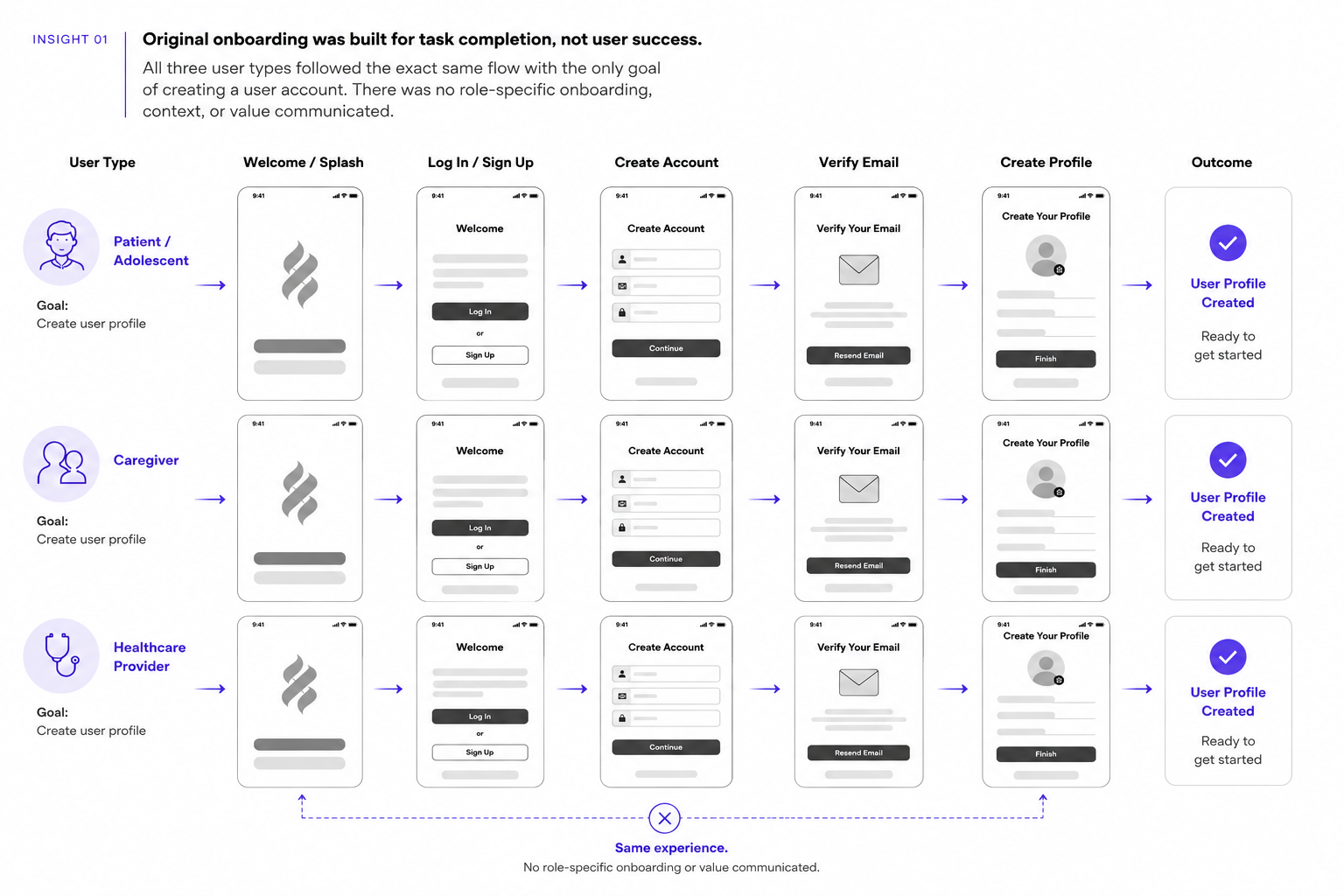
Onboarding Was Built Around Tasks, Not Understanding
The experience prioritized workflow completion over user comprehension, creating unnecessary friction during the most critical stage of adoption.
Key issues identified:
- Unclear role-specific pathways
- Limited benefit communication
- Weak feedback and progress indicators
- Inconsistent error handling and guidance
The experience prioritized completion over comprehension, creating unnecessary friction during the most critical stage of adoption.
KEY INSIGHT 02
Users Needed Decisions, Not Data
Patients, caregivers, and clinicians were all viewing the same underlying health information, but they were trying to answer very different questions.
Patients wanted to know what action to take next.
Caregivers wanted to know when intervention was needed.
Clinicians wanted confidence that reported behaviors reflected real world activity.
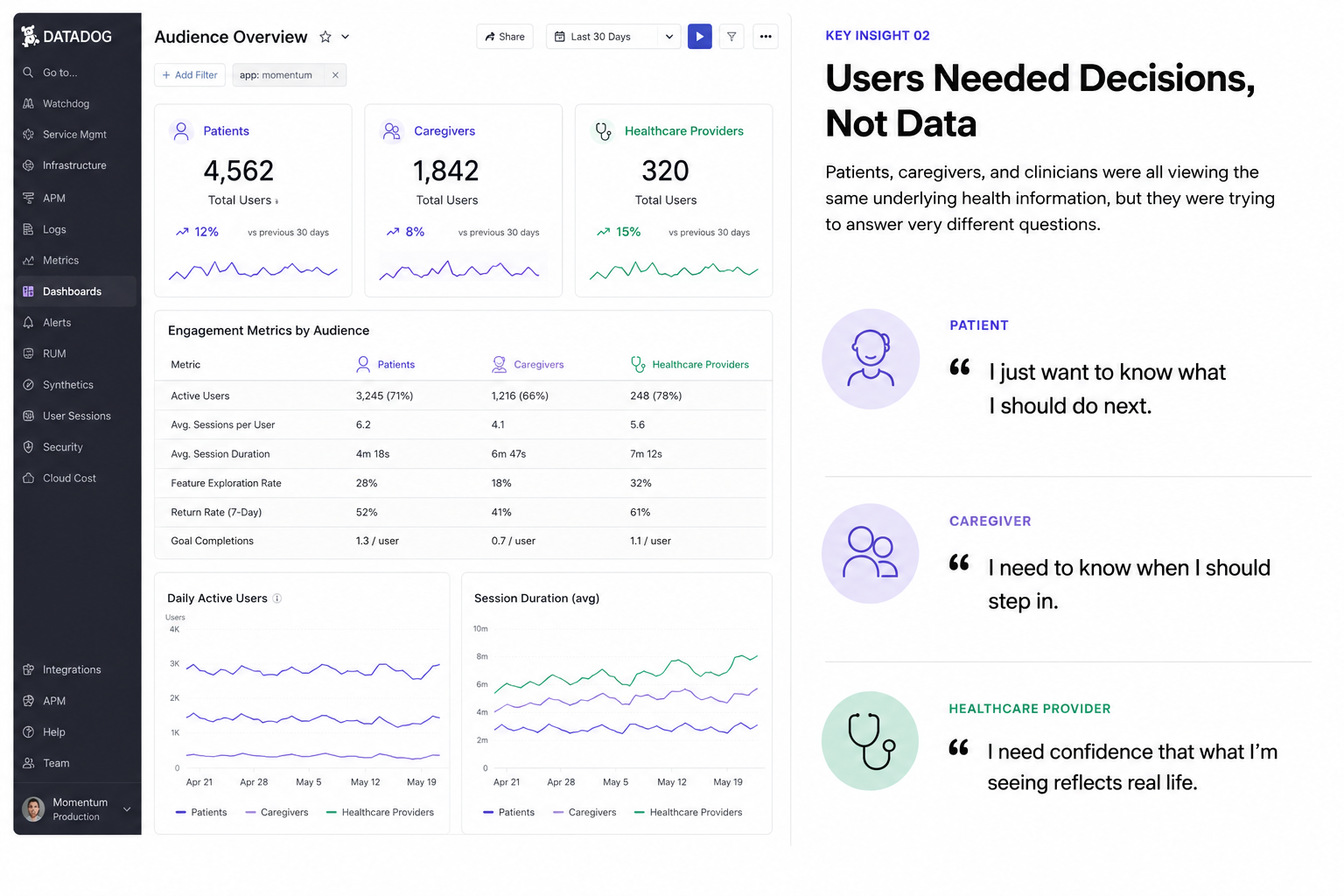
The platform delivered data. Users needed guidance.
Research showed users spent more effort interpreting information than acting on it.
What the research revealed
- Patients struggled to connect behaviors to outcomes
- Caregivers lacked visibility into emerging risks
- Clinicians spent time validating information rather than making decisions
- Shared dashboards created cognitive overload across user groups
KEY INSIGHT 03
Adherence Was Influenced by People, Not Just Technology
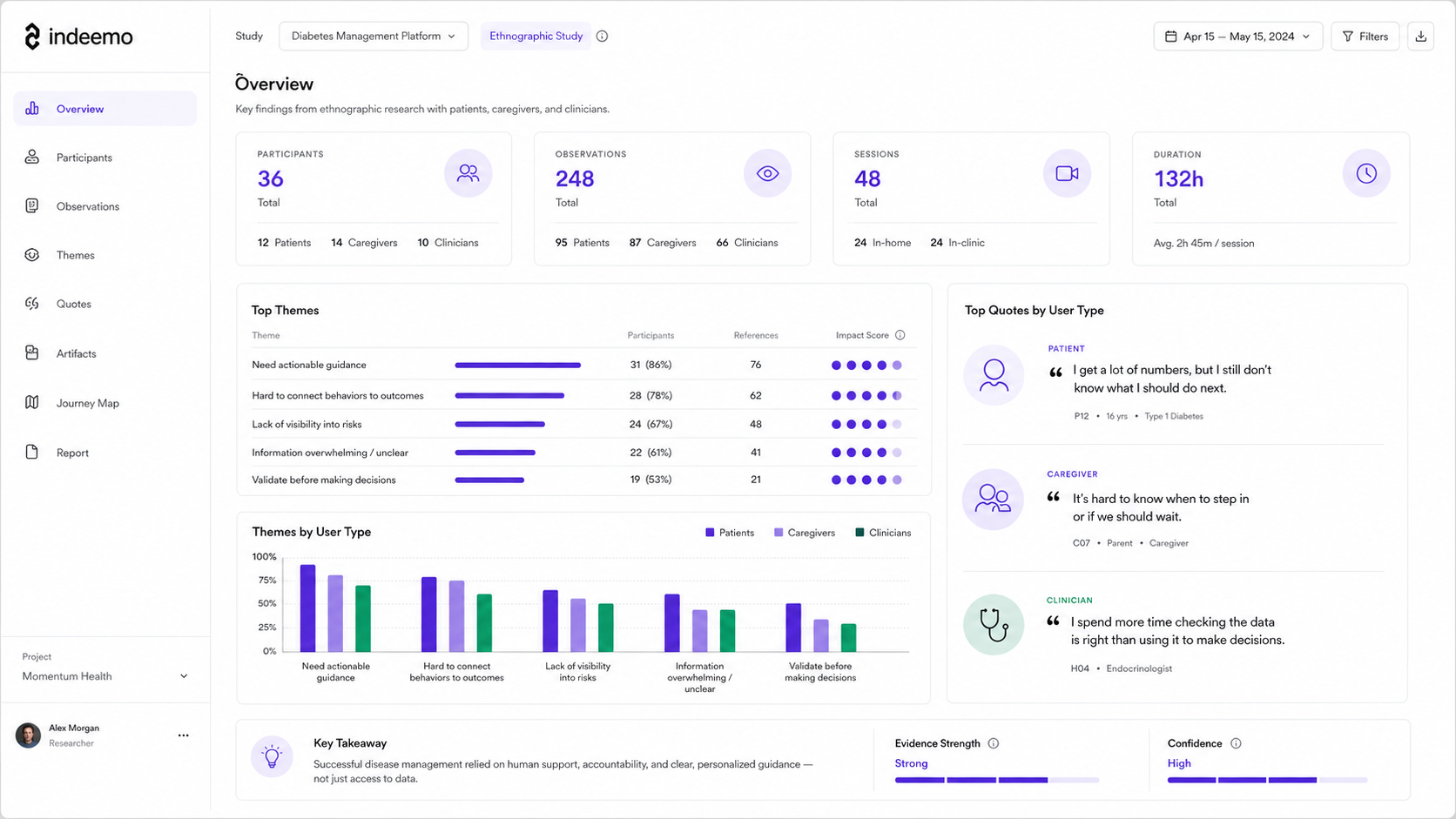
Ethnographic research revealed that successful disease management rarely happened in isolation.
Patients relied on caregivers for reminders, encouragement, accountability, and help interpreting information. Clinicians depended on both groups to consistently capture and communicate meaningful health data.
While the platform focused on individual app usage, real-world adherence was shaped by an interconnected support system operating outside the application itself.
The technology was only one part of the experience. Human relationships drove behavior.
The Strategy
Designing a Behavioral System Around Three Distinct Users
Research revealed that patients, caregivers, and clinicians were trying to accomplish fundamentally different goals, yet the platform treated them as a single audience.
The solution was not to optimize individual screens. It was to redesign the system around the behaviors, decisions, and support needs of each role.
I transformed the experience from a shared data platform into a coordinated behavioral ecosystem where onboarding, dashboards, and reinforcement mechanisms worked together to support long-term adherence.

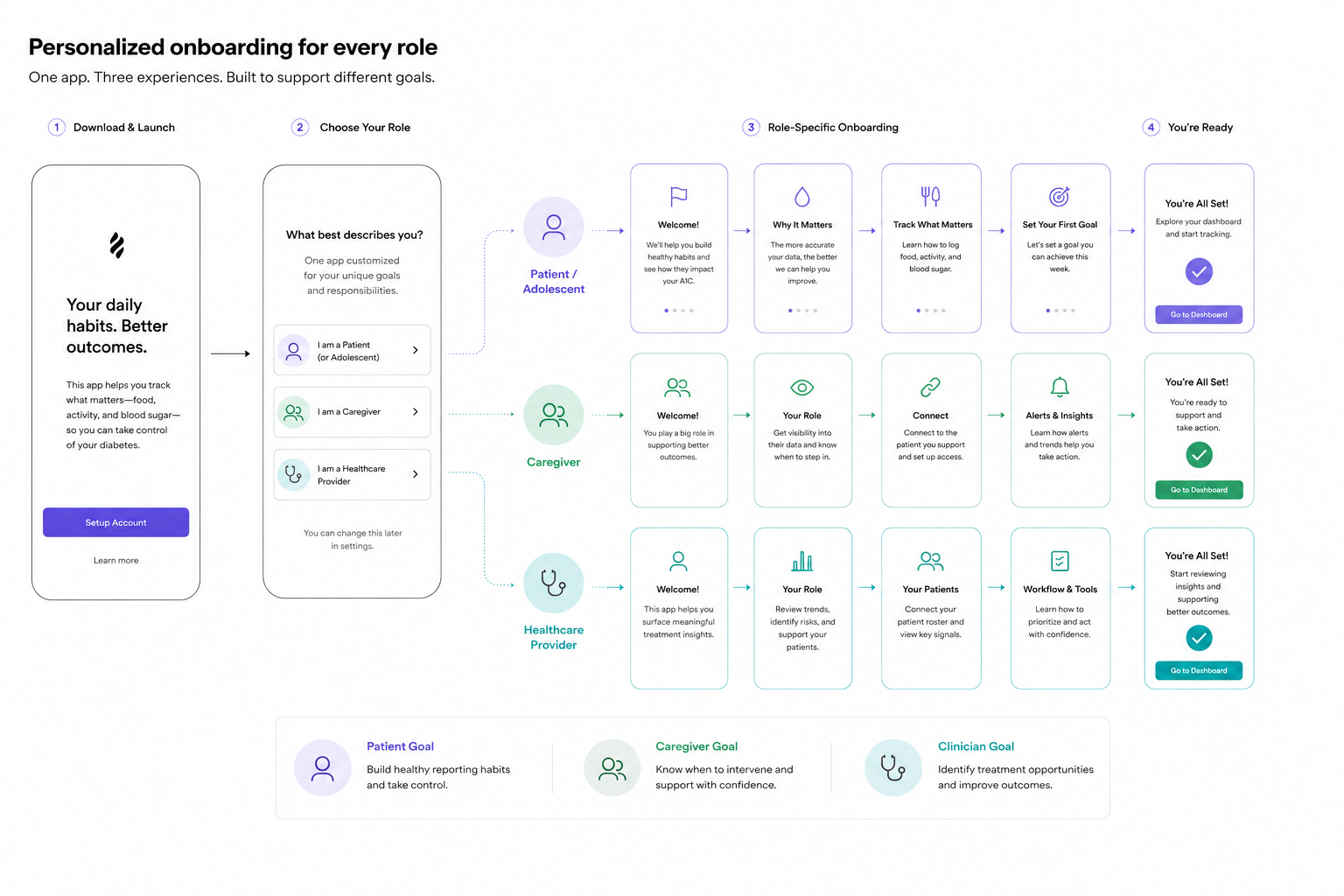
Personalizing onboarding around each user's role, goals, and level of digital literacy
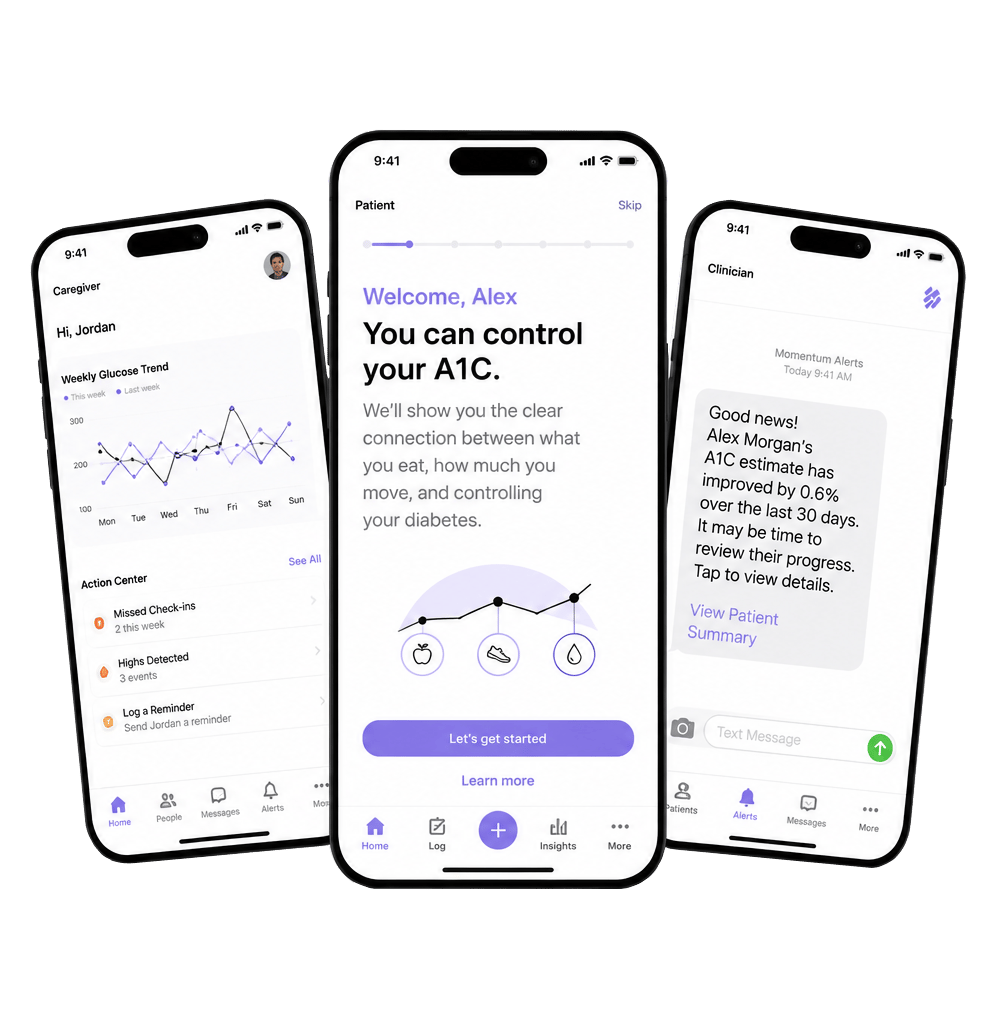
Patients received guided onboarding focused on building healthy reporting habits and understanding why accurate data mattered. Caregivers received support centered on oversight and intervention, while clinicians were introduced to workflows designed to surface meaningful treatment insights.

Designing role-specific dashboards around actions rather than data
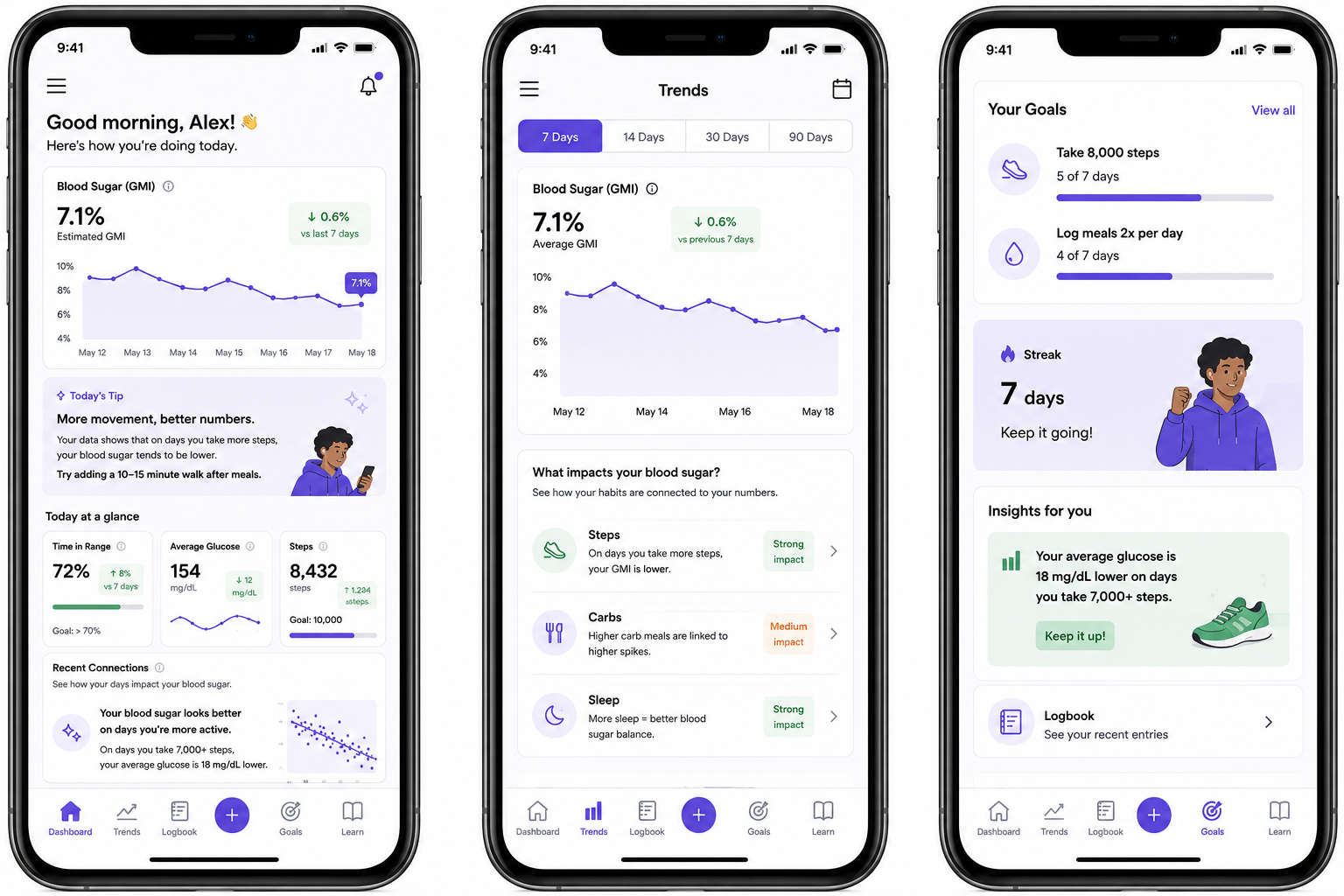
Patients saw blood sugar trends connected to daily behaviors, caregivers saw adherence signals requiring attention, and clinicians received prioritized patient insights designed to support intervention and treatment decisions.

Extending support beyond the application through coordinated behavioral reinforcement
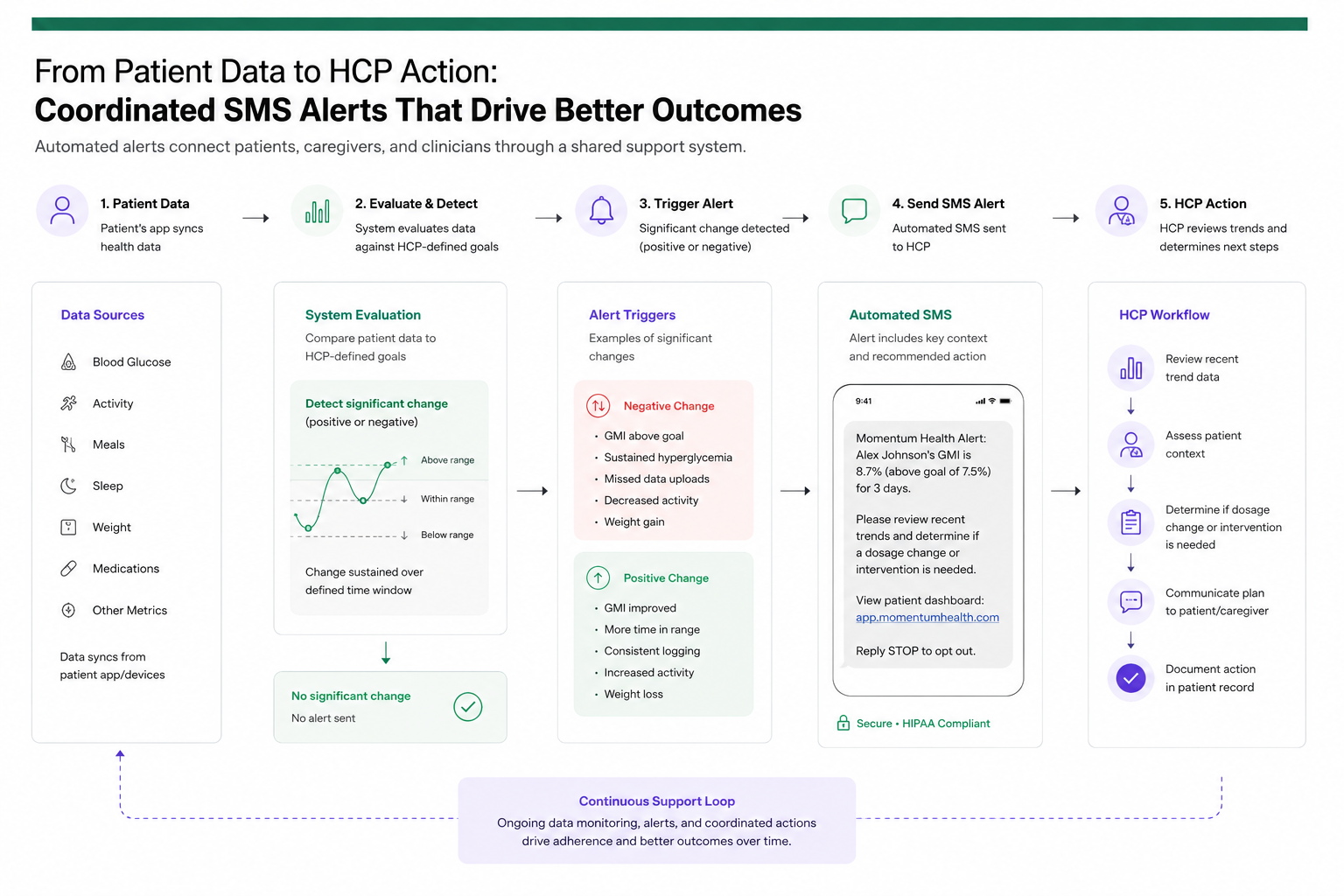
Automated SMS alerts, email notifications, and intervention triggers connected patients, caregivers, and clinicians through a shared support system designed to improve adherence between platform sessions.
The Impact
From Behavioral Design to Measurable Adoption
By redesigning the platform around the unique needs of patients, caregivers, and clinicians, Momentum transformed from a passive tracking tool into a coordinated adherence support system.
Rather than optimizing individual screens, the work focused on improving understanding, reinforcing healthy behaviors, and creating stronger connections between patients and their support network.
Following implementation, adoption and engagement improved across multiple measures:
84%
Onboarding Completion

58%
From the Previous Month

71%
7-Day Retention
49%
WoW Trends From the Previous Month
81%
Walkthrough Completion

31%
From the Previous Quarter

Engagement improved because the platform aligned support to each user's goals, responsibilities, and behavioral context.
Patients received clearer guidance.
Caregivers gained better visibility into adherence risks.
Clinicians spent less time interpreting data and more time identifying intervention opportunities.
Better outcomes didn't come from collecting more data.
They came from helping the right people take the right action at the right time.
Case Studies
Healthcare SaaS • Research • Retention

Trust in the AI Was Lost at Login
Protecting Clinical Momentum in an AI-Powered EHR
A mixed-method research initiative uncovered how authentication friction reduced confidence in AI-assisted documentation and disrupted critical prescribing workflows →
↑ Workflow Continuity • ↑ Clinician Confidence • ↓ Authentication Friction
FinTech • B2B SaaS • DX Strategy • Acquisition

A Strong Product. The Wrong Customers.
Building Around the Right Customer Changed Everything.
Behavioral analysis uncovered which customers actually drove revenue reshaping acquisition, onboarding, and growth strategy around their needs →
↑ 250% Organic Acquisition • ↑ 78% High-Value Accounts • ↓ 70% CPL
GovTech • SaaS CRM • DX + DAP Strategy • Onboarding

Adoption Was Breaking the Moving Process
Fixing Operational Friction Changed How Military Moves Happened
Workflow analysis uncovered how onboarding, authentication, and inventory failures created cascading delays across the moving ecosystem; reshaping digital adoption around operational reality →
↓ 14x Login Support Volume • ↑ Faster Time-to-Activation • ↓ Inventory Escalations
My Expertise Delivers For:
Marketing & Growth
Customer Acquisition & Conversion
Journey Mapping & Funnel Optimization
CRM & Retention Strategy
Behavioral Segmentation & Personalization
Landing Page & Onboarding Optimization
Customer Research & Insight Generation
AI-Supported Content & Experience Strategy
Product & CX
UX & Digital Experience Strategy
Onboarding & Adoption Systems
DAP Strategy & Optimization
Service Blueprinting
Customer & Employee Experience
Behavioral Design & Usability Optimization
AI-supported Product & Support Experiences
Strategy & Transformation
Cross-functional Alignment
Experience Transformation Initiatives
Operational Experience Design
Customer Intelligence Systems
Support and Onboarding Optimization
Research-driven Decision-making
AI-supported Workflow and Systems Strategy
Let’s Build Better Systems for People

© 2026 Beth Pavinich. All rights reserved.
All content, case studies, strategy frameworks, written materials, visuals, diagrams, concepts, and supporting artifacts featured on this site are the intellectual property of Beth Pavinich and may not be copied, reproduced, distributed, modified, adapted, republished, or used in whole or in part without prior written permission.
Many projects featured on this site were completed under non-disclosure agreements (NDAs). Client names and proprietary details have been anonymized. Outcomes reflect engagement-specific performance data, client reporting, benchmark analysis, and directional business impact estimates where exact figures cannot be disclosed.

Influencing Behavior
Through Better Design
A research-led redesign transformed a companion health platform from a passive tracking tool into a coordinated behavioral support system—improving onboarding, retention, and adherence across patients, caregivers, and clinicians.
ROLE
Digital Experience Strategy Consultant
OWNERSHIP
End-to-end research, Behavioral design & digital adoption strategy
///
///
///
Overview
Momentum was a companion health platform designed to help adolescents with Type II Diabetes build healthier habits and improve long-term outcomes.
The platform connected three audiences through a shared digital experience:
- Patients
- Caregivers
- Clinicians
Integrated with connected glucose monitoring technology, Momentum helped users track health behaviors, progress toward treatment goals, and ongoing adherence activities.
The vision was simple:
Help patients build sustainable habits while giving caregivers and clinicians visibility into progress.
The technology worked.
Engagement didn't.
The Problem
Low Adoption. Misaligned Experiences.
Task completion rates were low.
Onboarding drop-off was high.
Clinical teams questioned the reliability of patient-reported behaviors.
At a glance, the issue appeared behavioral:
Patients weren't completing activities.
Engagement declined after onboarding.
Health goals were being abandoned.
But research told a different story:
Patients, caregivers, and clinicians had fundamentally different needs.
The experience treated all three groups as if they behaved the same.
Critical workflows created unnecessary cognitive load.
Users lacked confidence that the platform supported their role effectively.
Research + Validation
One System. Three Different Behaviors.
Through observational research, usability testing, workflow analysis, and behavioral segmentation, I examined how each user group interacted with the platform.
Adolescents
Needed simple, immediate feedback and struggled with complex onboarding and task structures.
Caregivers
Wanted visibility, reassurance, and clear indicators of when intervention was needed.
Clinicians
Needed confidence that reported activity reflected real-world behavior and supported treatment decisions.
The platform's shared dashboard model failed all three groups in different ways. The concern wasn't technology. It was trust. When users lose confidence in the system, engagement quickly follows.
KEY INSIGHT 01
Onboarding Was Built Around Tasks, Not Understanding
The experience prioritized workflow completion over user comprehension, creating unnecessary friction during the most critical stage of adoption.
Key issues identified:
- Unclear role-specific pathways
- Limited benefit communication
- Weak feedback and progress indicators
- Inconsistent error handling and guidance
The experience prioritized completion over comprehension, creating unnecessary friction during the most critical stage of adoption.
KEY INSIGHT 02
Users Needed Decisions, Not Data
Patients, caregivers, and clinicians were all viewing the same underlying health information, but they were trying to answer very different questions.
Patients wanted to know what action to take next.
Caregivers wanted to know when intervention was needed.
Clinicians wanted confidence that reported behaviors reflected real world activity.
The platform delivered data. Users needed guidance.
Research showed users spent more effort interpreting information than acting on it.
What the research revealed
- Patients struggled to connect behaviors to outcomes
- Caregivers lacked visibility into emerging risks
- Clinicians spent time validating information rather than making decisions
- Shared dashboards created cognitive overload across user groups
KEY INSIGHT 03
Adherence Was Influenced by People, Not Just Technology
Ethnographic research revealed that successful disease management rarely happened in isolation.
Patients relied on caregivers for reminders, encouragement, accountability, and help interpreting information. Clinicians depended on both groups to consistently capture and communicate meaningful health data.
While the platform focused on individual app usage, real-world adherence was shaped by an interconnected support system operating outside the application itself.
The technology was only one part of the experience. Human relationships drove behavior.
The Strategy
Designing a Behavioral System Around Three Distinct Users
Research revealed that patients, caregivers, and clinicians were trying to accomplish fundamentally different goals, yet the platform treated them as a single audience.
The solution was not to optimize individual screens. It was to redesign the system around the behaviors, decisions, and support needs of each role.
I transformed the experience from a shared data platform into a coordinated behavioral ecosystem where onboarding, dashboards, and reinforcement mechanisms worked together to support long-term adherence.

Personalizing onboarding around each user's role, goals, and level of digital literacy
Patients received guided onboarding focused on building healthy reporting habits and understanding why accurate data mattered. Caregivers received support centered on oversight and intervention, while clinicians were introduced to workflows designed to surface meaningful treatment insights.

Designing role-specific dashboards around actions rather than data
Patients saw blood sugar trends connected to daily behaviors, caregivers saw adherence signals requiring attention, and clinicians received prioritized patient insights designed to support intervention and treatment decisions.

Extending support beyond the application through coordinated behavioral reinforcement
Automated SMS alerts, email notifications, and intervention triggers connected patients, caregivers, and clinicians through a shared support system designed to improve adherence between platform sessions.
The Impact
From Behavioral Design to Measurable Adoption
By redesigning the platform around the unique needs of patients, caregivers, and clinicians, Momentum transformed from a passive tracking tool into a coordinated adherence support system.
Rather than optimizing individual screens, the work focused on improving understanding, reinforcing healthy behaviors, and creating stronger connections between patients and their support network.
Following implementation, adoption and engagement improved across multiple measures:
84%
Onboarding Completion
58%
From the Previous Month
71%
7-Day Retention
49%
WoW Trends From the Previous Month
81%
Walkthrough Completion
31%
From the Previous Quarter
Engagement improved because the platform aligned support to each user's goals, responsibilities, and behavioral context.
Patients received clearer guidance.
Caregivers gained better visibility into adherence risks.
Clinicians spent less time interpreting data and more time identifying intervention opportunities.
Better outcomes didn't come from collecting more data.
They came from helping the right people take the right action at the right time.
Case Studies
Trust in the AI Was Lost at Login
Protecting Clinical Momentum in an AI-Powered EHR
A mixed-method research initiative uncovered how authentication friction reduced confidence in AI-assisted documentation and disrupted critical prescribing workflows →
↑ Workflow Continuity • ↑ Clinician Confidence • ↓ Authentication Friction

Healthcare SaaS • Research • Retention
A Strong Product. The Wrong Customers.
Building Around the Right Customer Changed Everything.
Behavioral analysis uncovered which customers actually drove revenue reshaping acquisition, onboarding, and growth strategy around their needs →
↑ 250% Organic Acquisition • ↑ 78% High-Value Accounts • ↓ 70% CPL
FinTech • B2B SaaS • DX Strategy • Acquisition
Adoption Was Breaking the Moving Process
Fixing Operational Friction Changed How Military Moves Happened
Workflow analysis uncovered how onboarding, authentication, and inventory failures created cascading delays across the moving ecosystem; reshaping digital adoption around operational reality →
↓ 14x Login Support Volume • ↑ Faster Time-to-Activation • ↓ Inventory Escalations
GovTech • SaaS CRM • DX + DAP Strategy • Onboarding
My Expertise Delivers For:
Marketing & Growth
Customer Acquisition & Conversion
Journey Mapping & Funnel Optimization
CRM & Retention Strategy
Behavioral Segmentation & Personalization
Landing Page & Onboarding Optimization
Customer Research & Insight Generation
AI-Supported Content & Experience Strategy
Product & CX
UX & Digital Experience Strategy
Onboarding & Adoption Systems
DAP Strategy & Optimization
Service Blueprinting
Customer & Employee Experience
Behavioral Design & Usability Optimization
AI-supported Product & Support Experiences
Strategy & Transformation
Cross-functional Alignment
Experience Transformation Initiatives
Operational Experience Design
Customer Intelligence Systems
Support and Onboarding Optimization
Research-driven Decision-making
AI-supported Workflow and Systems Strategy
Let’s Build Better Systems for People
© 2026 Beth Pavinich. All rights reserved.
All content, case studies, strategy frameworks, written materials, visuals, diagrams, concepts, and supporting artifacts featured on this site are the intellectual property of Beth Pavinich and may not be copied, reproduced, distributed, modified, adapted, republished, or used in whole or in part without prior written permission.
Many projects featured on this site were completed under non-disclosure agreements (NDAs). Client names and proprietary details have been anonymized. Outcomes reflect engagement-specific performance data, client reporting, benchmark analysis, and directional business impact estimates where exact figures cannot be disclosed.

Influencing Behavior
Through Better Design
A research-led redesign transformed a companion health platform from a passive tracking tool into a coordinated behavioral support system—improving onboarding, retention, and adherence across patients, caregivers, and clinicians.
ROLE
Digital Experience Strategy Consultant
OWNERSHIP
End-to-end research, Behavioral design & digital adoption strategy
///
///
///
Overview
Momentum was a companion health platform designed to help adolescents with Type II Diabetes build healthier habits and improve long-term outcomes.
The platform connected three audiences through a shared digital experience:
- Patients
- Caregivers
- Clinicians
Integrated with connected glucose monitoring technology, Momentum helped users track health behaviors, progress toward treatment goals, and ongoing adherence activities.
The vision was simple:
Help patients build sustainable habits while giving caregivers and clinicians visibility into progress.
The technology worked.
Engagement didn't.
The Problem
Low Adoption. Misaligned Experiences.
Task completion rates were low.
Onboarding drop-off was high.
Clinical teams questioned the reliability of patient-reported behaviors.
At a glance, the issue appeared behavioral:
Patients weren't completing activities.
Engagement declined after onboarding.
Health goals were being abandoned.
But research told a different story:
Patients, caregivers, and clinicians had fundamentally different needs.
The experience treated all three groups as if they behaved the same.
Critical workflows created unnecessary cognitive load.
Users lacked confidence that the platform supported their role effectively.
Research + Validation
One System. Three Different Behaviors.
Through observational research, usability testing, workflow analysis, and behavioral segmentation, I examined how each user group interacted with the platform.
Adolescents
Needed simple, immediate feedback and struggled with complex onboarding and task structures.
Caregivers
Wanted visibility, reassurance, and clear indicators of when intervention was needed.
Clinicians
Needed confidence that reported activity reflected real-world behavior and supported treatment decisions.
The platform's shared dashboard model failed all three groups in different ways. The concern wasn't technology. It was trust. When users lose confidence in the system, engagement quickly follows.
KEY INSIGHT 01
Onboarding Was Built Around Tasks, Not Understanding
The experience prioritized workflow completion over user comprehension, creating unnecessary friction during the most critical stage of adoption.
Key issues identified:
- Unclear role-specific pathways
- Limited benefit communication
- Weak feedback and progress indicators
- Inconsistent error handling and guidance
The experience prioritized completion over comprehension, creating unnecessary friction during the most critical stage of adoption.
KEY INSIGHT 02
Users Needed Decisions, Not Data
Patients, caregivers, and clinicians were all viewing the same underlying health information, but they were trying to answer very different questions.
Patients wanted to know what action to take next.
Caregivers wanted to know when intervention was needed.
Clinicians wanted confidence that reported behaviors reflected real world activity.
The platform delivered data. Users needed guidance.
Research showed users spent more effort interpreting information than acting on it.
What the research revealed
- Patients struggled to connect behaviors to outcomes
- Caregivers lacked visibility into emerging risks
- Clinicians spent time validating information rather than making decisions
- Shared dashboards created cognitive overload across user groups
KEY INSIGHT 03
Adherence Was Influenced by People, Not Just Technology
Ethnographic research revealed that successful disease management rarely happened in isolation.
Patients relied on caregivers for reminders, encouragement, accountability, and help interpreting information. Clinicians depended on both groups to consistently capture and communicate meaningful health data.
While the platform focused on individual app usage, real-world adherence was shaped by an interconnected support system operating outside the application itself.
The technology was only one part of the experience. Human relationships drove behavior.
The Strategy
Designing a Behavioral System Around Three Distinct Users
Research revealed that patients, caregivers, and clinicians were trying to accomplish fundamentally different goals, yet the platform treated them as a single audience.
The solution was not to optimize individual screens. It was to redesign the system around the behaviors, decisions, and support needs of each role.
I transformed the experience from a shared data platform into a coordinated behavioral ecosystem where onboarding, dashboards, and reinforcement mechanisms worked together to support long-term adherence.

Personalizing onboarding around each user's role, goals, and level of digital literacy
Patients received guided onboarding focused on building healthy reporting habits and understanding why accurate data mattered. Caregivers received support centered on oversight and intervention, while clinicians were introduced to workflows designed to surface meaningful treatment insights.

Designing role-specific dashboards around actions rather than data
Patients saw blood sugar trends connected to daily behaviors, caregivers saw adherence signals requiring attention, and clinicians received prioritized patient insights designed to support intervention and treatment decisions.

Extending support beyond the application through coordinated behavioral reinforcement
Automated SMS alerts, email notifications, and intervention triggers connected patients, caregivers, and clinicians through a shared support system designed to improve adherence between platform sessions.
The Impact
From Behavioral Design to Measurable Adoption
By redesigning the platform around the unique needs of patients, caregivers, and clinicians, Momentum transformed from a passive tracking tool into a coordinated adherence support system.
Rather than optimizing individual screens, the work focused on improving understanding, reinforcing healthy behaviors, and creating stronger connections between patients and their support network.
Following implementation, adoption and engagement improved across multiple measures:
84%
Onboarding Completion
58%
From the Previous Month
71%
7-Day Retention
49%
WoW Trends From the Previous Month
81%
Walkthrough Completion
31%
From the Previous Quarter
Engagement improved because the platform aligned support to each user's goals, responsibilities, and behavioral context.
Patients received clearer guidance.
Caregivers gained better visibility into adherence risks.
Clinicians spent less time interpreting data and more time identifying intervention opportunities.
Better outcomes didn't come from collecting more data.
They came from helping the right people take the right action at the right time.
Case Studies
Healthcare SaaS • Research • Retention
Trust in the AI Was Lost at Login
Protecting Clinical Momentum in an AI-Powered EHR
A mixed-method research initiative uncovered how authentication friction reduced confidence in AI-assisted documentation and disrupted critical prescribing workflows →
↑ Workflow Continuity • ↑ Clinician Confidence •
↓ Authentication Friction
FinTech • B2B SaaS • DX Strategy • Acquisition
A Strong Product. The Wrong Customers.
Building Around the Right Customer Changed Everything.
Behavioral analysis uncovered which customers actually drove revenue reshaping acquisition, onboarding, and growth strategy around their needs →
↑ 250% Organic Acquisition • ↑ 78% High-Value Accounts • ↓ 70% CPL
GovTech • SaaS CRM • DX + DAP Strategy • Onboarding
Adoption Was Breaking the Moving Process
Fixing Operational Friction Changed How Military Moves Happened
Workflow analysis uncovered how onboarding, authentication, and inventory failures created cascading delays across the moving ecosystem; reshaping digital adoption around operational reality →
↓ 14x Login Support Volume • ↑ Faster Time-to-Activation • ↓ Inventory Escalations
My Expertise Delivers For:
Marketing & Growth
Customer Acquisition & Conversion
Journey Mapping & Funnel Optimization
CRM & Retention Strategy
Behavioral Segmentation & Personalization
Landing Page & Onboarding Optimization
Customer Research & Insight Generation
AI-Supported Content & Experience Strategy
Product & CX
UX & Digital Experience Strategy
Onboarding & Adoption Systems
DAP Strategy & Optimization
Service Blueprinting
Customer & Employee Experience
Behavioral Design & Usability Optimization
AI-supported Product & Support Experiences
Strategy & Transformation
Cross-functional Alignment
Experience Transformation Initiatives
Operational Experience Design
Customer Intelligence Systems
Support and Onboarding Optimization
Research-driven Decision-making
AI-supported Workflow and Systems Strategy
Let’s Build Better Systems for People
© 2026 Beth Pavinich. All rights reserved.
All content, case studies, strategy frameworks, written materials, visuals, diagrams, concepts, and supporting artifacts featured on this site are the intellectual property of Beth Pavinich and may not be copied, reproduced, distributed, modified, adapted, republished, or used in whole or in part without prior written permission.
Many projects featured on this site were completed under non-disclosure agreements (NDAs). Client names and proprietary details have been anonymized. Outcomes reflect engagement-specific performance data, client reporting, benchmark analysis, and directional business impact estimates where exact figures cannot be disclosed.