
When Organic Enrollment Growth Plateaued,
Traffic Wasn’t the Problem

What started as a 30-day UX and CRO validation initiative evolved into a research-driven strategy proving that enrollment friction, content hierarchy, and decision-stage usability (not traffic volume) were limiting growth.
ROLE
UX Research & CRO Strategy Lead
OWNERSHIP
Research-Driven Enrollment Optimization
Research & Validation
Better UX Wasn’t Assumed.
It Was Tested.
A research-informed landing page variant was developed and tested against the live enrollment experience using:
- Qualitative user feedback
- Heuristic UX evaluation
- Behavioral analysis
- Conversion-focused content restructuring
- Statistical comparison modeling
The goal wasn’t to redesign the experience visually. It was to determine whether better enrollment clarity and decision-stage usability could improve performance.
Key Finding 01
Prospective Students Needed Program Clarity Before Conversion
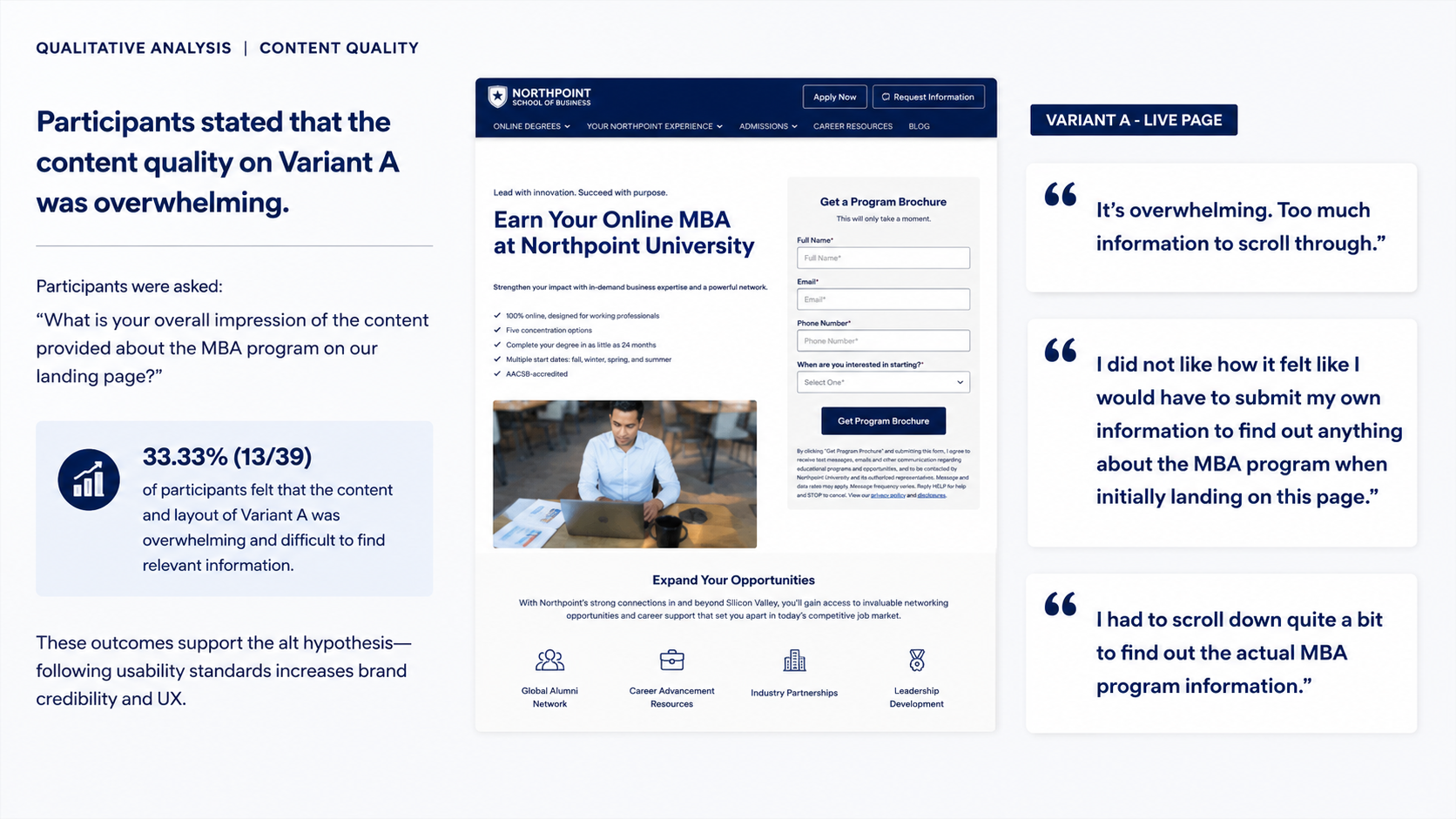
The research revealed that many prospective students felt pressured to submit personal information before they fully understood the MBA program itself.
Participants consistently asked for:
- Clearer program details
- Admissions expectations
- Curriculum visibility
- Tuition transparency
- Stronger proof of value
The findings showed that high-intent users were not resisting enrollment. They were struggling to confidently evaluate the program before taking the next step.
Key Finding 02
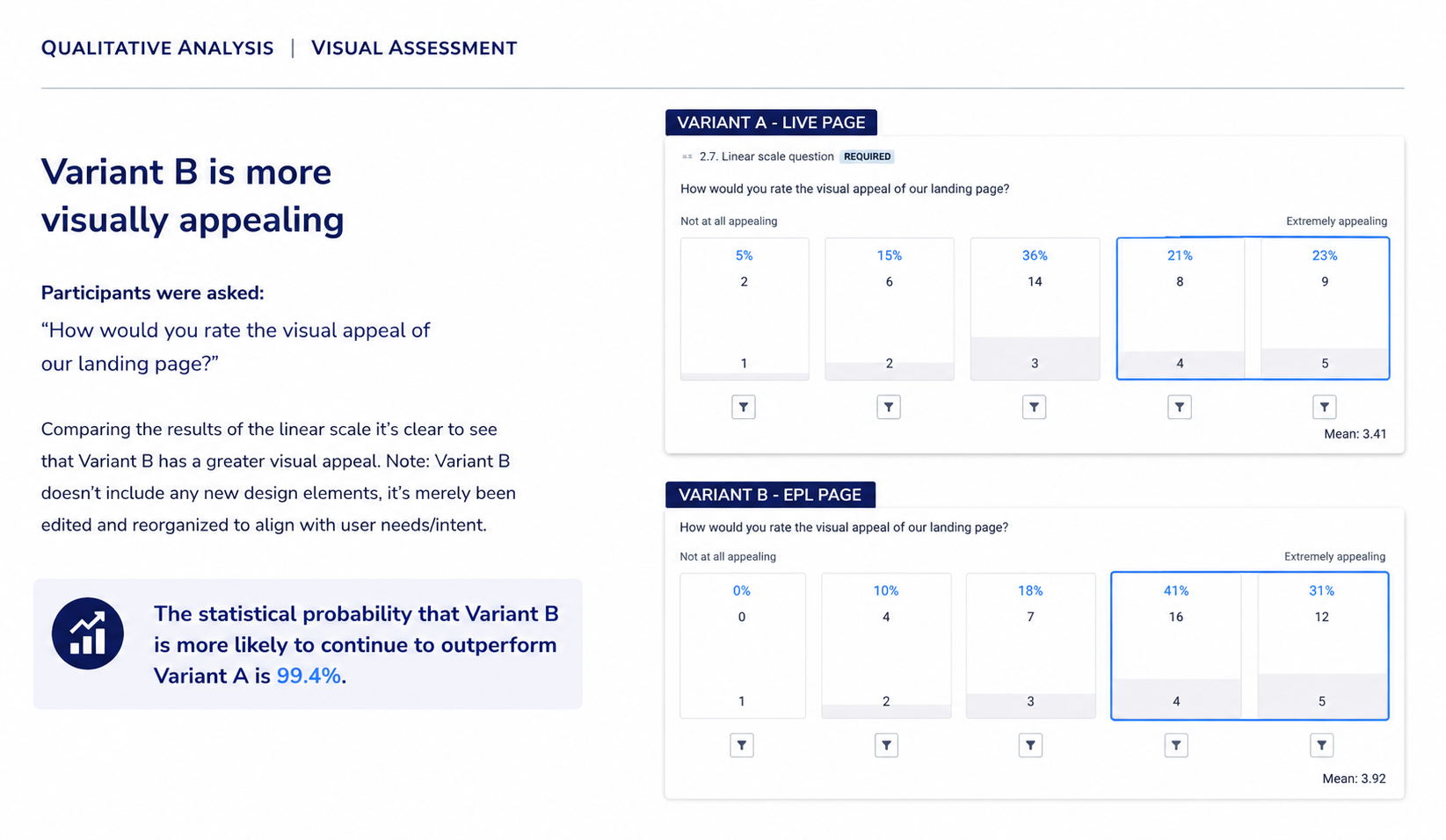
Content Hierarchy Had More Impact Than Visual Design
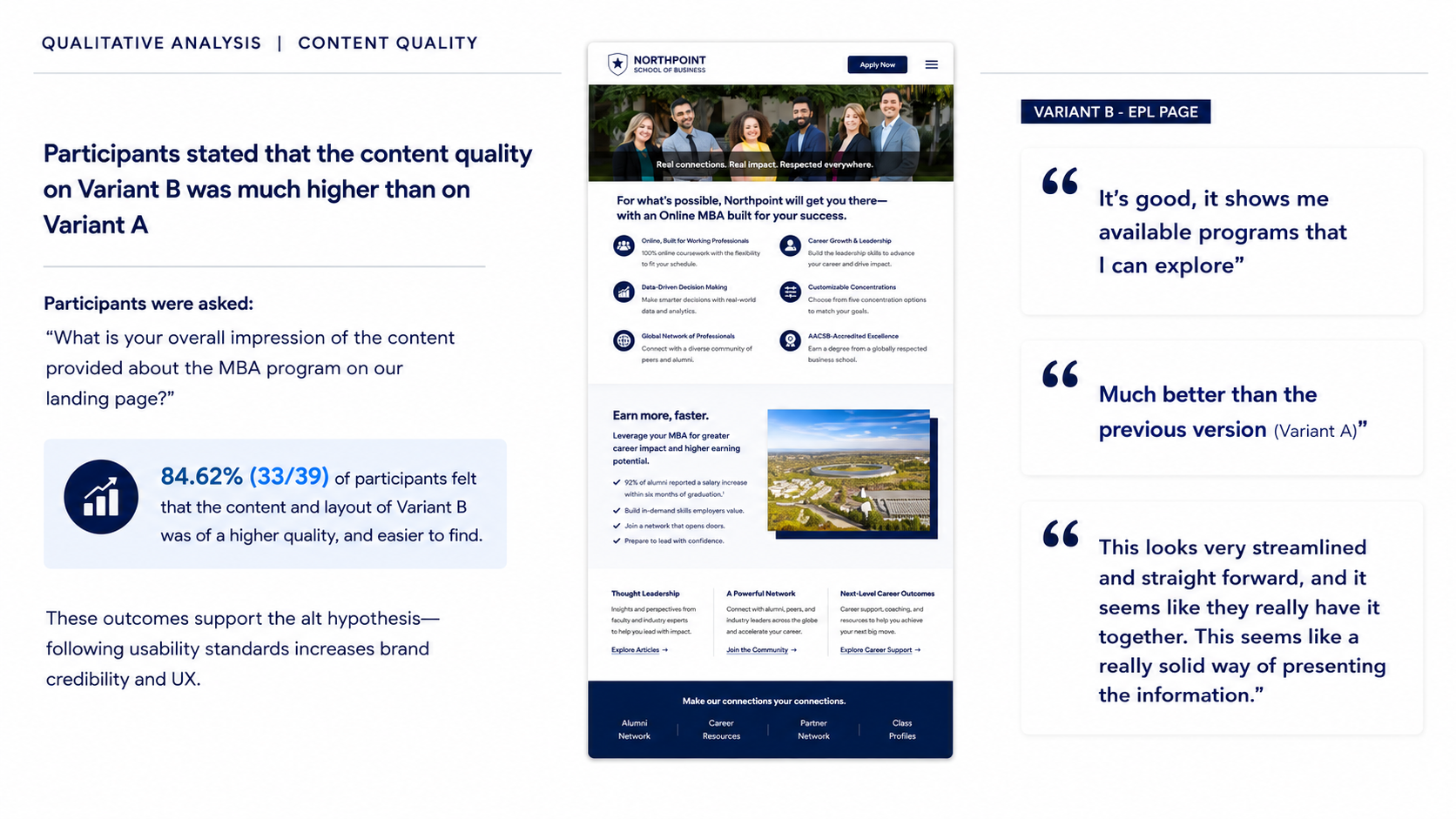
The highest-performing experience wasn’t visually redesigned from scratch.
Instead, performance improvements came from:
- Clearer information hierarchy
- Reduced cognitive overload
- Simplified navigation
- Better prioritization of program content
- Stronger alignment between search intent and enrollment information
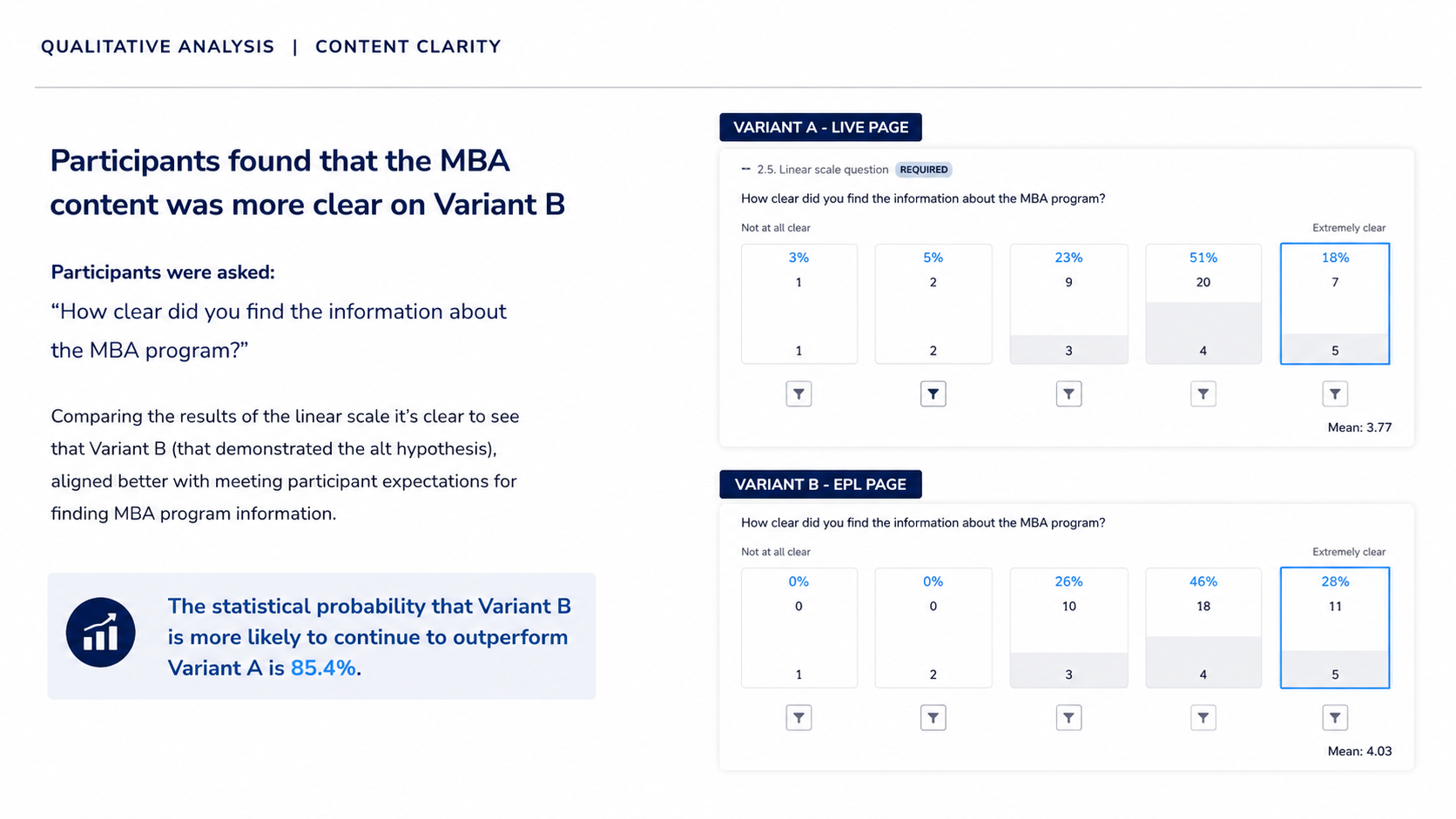
The research validated that usability and content clarity had a greater impact on conversion likelihood than visual redesign alone.
Key Finding 03
Decision-Stage Users Wanted Specificity, Not Institutional Messaging
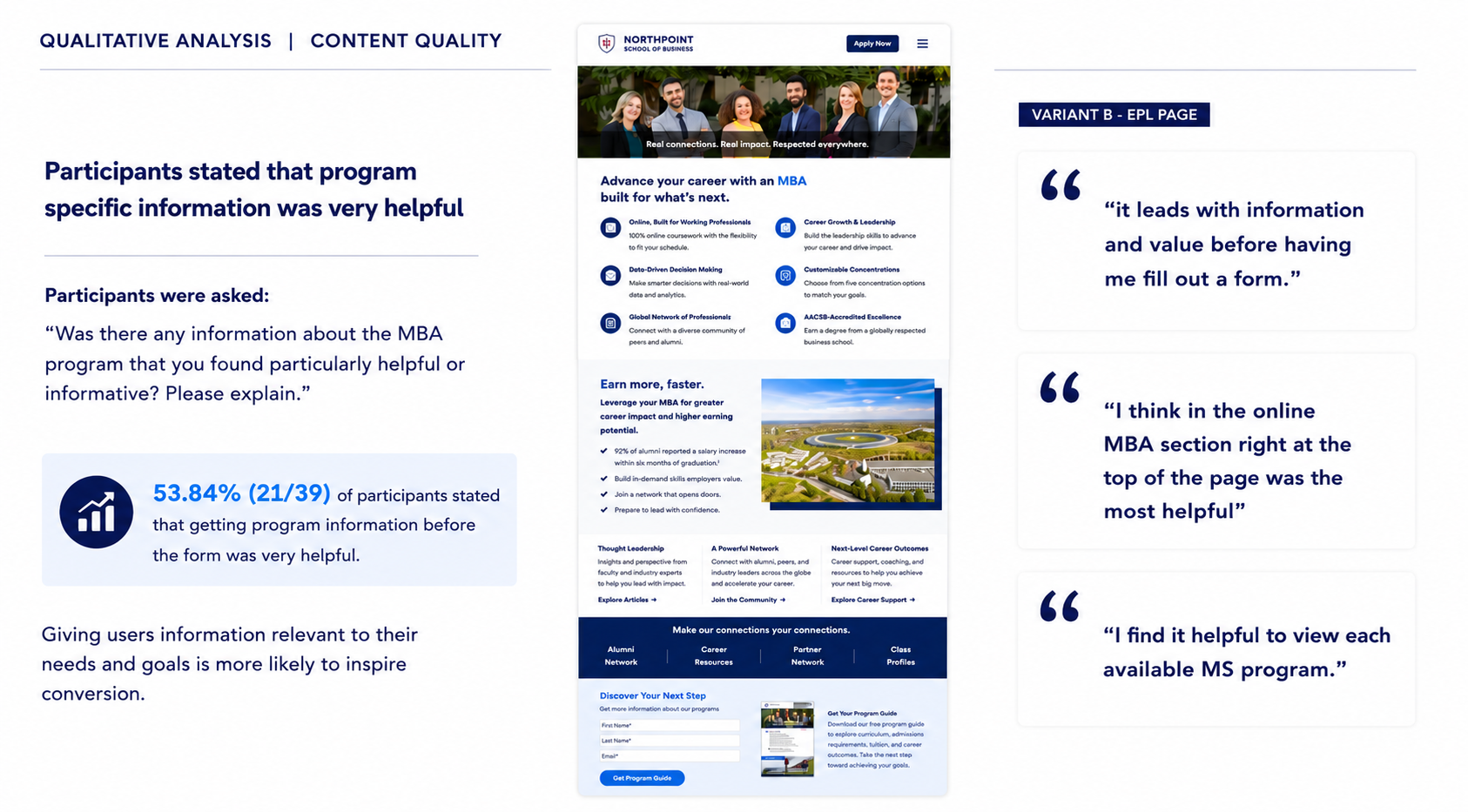
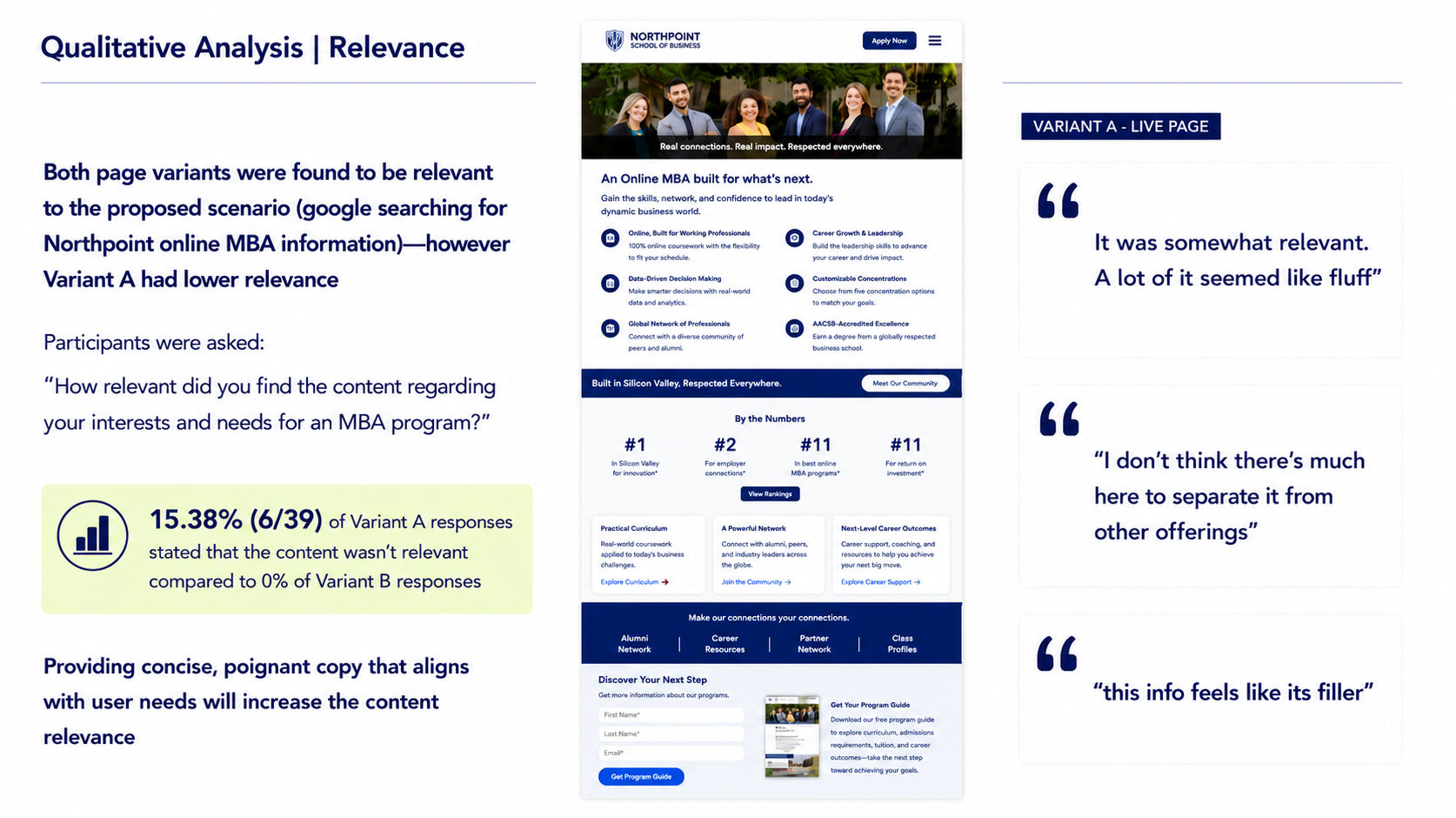
The strongest engagement signals came from program-specific content tied directly to enrollment decisions.
Participants consistently responded more positively to:
- Curriculum details
- Career outcomes
- Program structure
- Practical enrollment information
Generic institutional messaging and high-level promotional content were viewed as less persuasive during decision-stage evaluation.
The research showed that prospective students needed actionable clarity more than brand storytelling.
Key Finding 04
Missing Pricing Information Reduced Trust
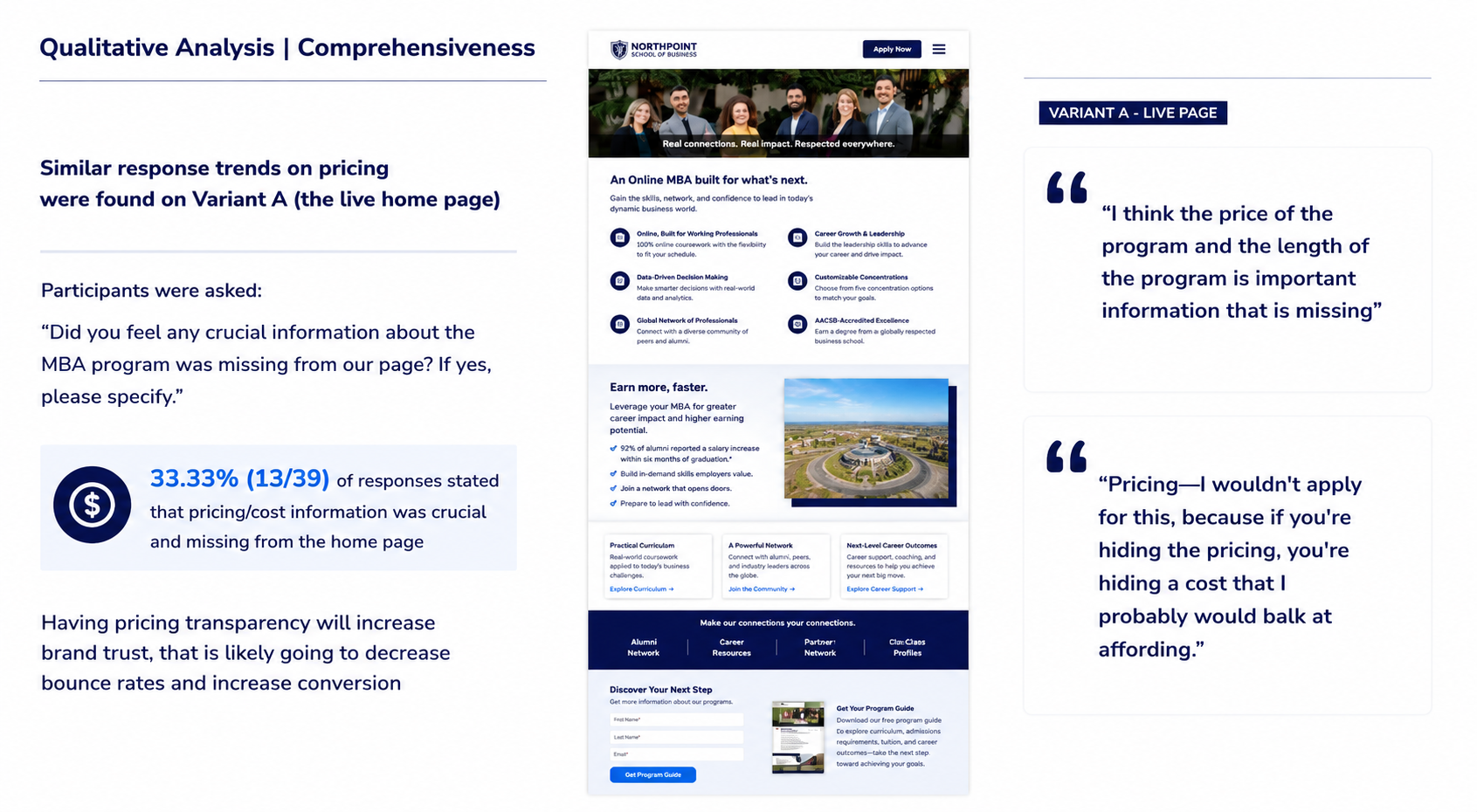
Participants repeatedly identified tuition and pricing transparency as missing from the enrollment experience.
Even highly interested users expressed hesitation when critical enrollment details were difficult to locate or omitted entirely.
The findings suggested that missing pricing information was creating uncertainty during evaluation and weakening enrollment confidence.
The Turning Point
The Research Validated a Larger CX Problem
The project didn’t just validate better UX.
It validated the need for a stronger enrollment experience strategy.
The initiative successfully proved that enrollment performance issues weren’t being caused by traffic acquisition alone.
The research and testing revealed that:
- Content hierarchy
- Decision-stage usability
- Information clarity
- Enrollment trust signals
were directly impacting how prospective students evaluated programs and moved toward conversion.
More importantly, the findings made it clear that isolated CRO tactics would continue to produce limited results without a broader customer experience strategy guiding how prospective students navigated enrollment journeys, evaluated program information, and moved through decision-stage decision-making.
The project validated the need for a more research-driven approach to enrollment experience design across the organization.
Case Studies
Higher Ed • Enrollment Strategy • CRO • Acquisition

Different students had different motivations
Growth Improved When Enrollment Became More Personal
Behavioral research uncovered what prospective students needed to believe before applying, reshaping enrollment strategy around relevance, trust, and career intent →
+40% Lead CVR • +52% Applications • +68% Engagement
FinTech • B2B SaaS • DX Strategy • Acquisition

A Strong Product. The Wrong Customers.
Building Around the Right Customer Changed Everything.
Behavioral analysis uncovered which customers actually drove revenue reshaping acquisition, onboarding, and growth strategy around their needs →
↑ 250% Organic Acquisition • ↑ 78% High-Value Accounts • ↓ 70% CPL
Pharma • Product Design • Retention

Improving Adoption Through Behavioral Design
Designing Around the Right Support System Changed Everything
Behavioral research, experience redesign, and coordinated support workflows helped users understand what mattered, what to do next, and when intervention was needed →
↑ Onboarding Completion • ↑ 7-Day Retention • ↓ Response Time
My Expertise Delivers For:
Marketing & Growth
Customer Acquisition & Conversion
Journey Mapping & Funnel Optimization
CRM & Retention Strategy
Behavioral Segmentation & Personalization
Landing Page & Onboarding Optimization
Customer Research & Insight Generation
AI-Supported Content & Experience Strategy
Product & CX
UX & Digital Experience Strategy
Onboarding & Adoption Systems
DAP Strategy & Optimization
Service Blueprinting
Customer & Employee Experience
Behavioral Design & Usability Optimization
AI-supported Product & Support Experiences
Strategy & Transformation
Cross-functional Alignment
Experience Transformation Initiatives
Operational Experience Design
Customer Intelligence Systems
Support and Onboarding Optimization
Research-driven Decision-making
AI-supported Workflow and Systems Strategy
Let’s Build Better Systems for People

© 2026 Beth Pavinich. All rights reserved.
All content, case studies, strategy frameworks, written materials, visuals, diagrams, concepts, and supporting artifacts featured on this site are the intellectual property of Beth Pavinich and may not be copied, reproduced, distributed, modified, adapted, republished, or used in whole or in part without prior written permission.
Many projects featured on this site were completed under non-disclosure agreements (NDAs). Client names and proprietary details have been anonymized. Outcomes reflect engagement-specific performance data, client reporting, benchmark analysis, and directional business impact estimates where exact figures cannot be disclosed.

When Organic Enrollment Growth Plateaued,
Traffic Wasn’t the Problem
What started as a 30-day UX and CRO validation initiative evolved into a research-driven strategy proving that enrollment friction, content hierarchy, and decision-stage usability (not traffic volume) were limiting growth.
ROLE
UX Research & CRO Strategy Lead
OWNERSHIP
Research-Driven Enrollment Optimization
Research & Validation
Better UX Wasn’t Assumed.
It Was Tested.
A research-informed landing page variant was developed and tested against the live enrollment experience using:
- Qualitative user feedback
- Heuristic UX evaluation
- Behavioral analysis
- Conversion-focused content restructuring
- Statistical comparison modeling
The goal wasn’t to redesign the experience visually. It was to determine whether better enrollment clarity and decision-stage usability could improve performance.
Key Finding 01
Prospective Students Needed Program Clarity Before Conversion
The research revealed that many prospective students felt pressured to submit personal information before they fully understood the MBA program itself.
Participants consistently asked for:
- Clearer program details
- Admissions expectations
- Curriculum visibility
- Tuition transparency
- Stronger proof of value
The findings showed that high-intent users were not resisting enrollment. They were struggling to confidently evaluate the program before taking the next step.
Key Finding 02
Content Hierarchy Had More Impact Than Visual Design
The highest-performing experience wasn’t visually redesigned from scratch.
Instead, performance improvements came from:
- Clearer information hierarchy
- Reduced cognitive overload
- Simplified navigation
- Better prioritization of program content
- Stronger alignment between search intent and enrollment information
The research validated that usability and content clarity had a greater impact on conversion likelihood than visual redesign alone.
Key Finding 03
Decision-Stage Users Wanted Specificity, Not Institutional Messaging
The strongest engagement signals came from program-specific content tied directly to enrollment decisions.
Participants consistently responded more positively to:
- Curriculum details
- Career outcomes
- Program structure
- Practical enrollment information
Generic institutional messaging and high-level promotional content were viewed as less persuasive during decision-stage evaluation.
The research showed that prospective students needed actionable clarity more than brand storytelling.
Key Finding 04
Missing Pricing Information Reduced Trust
Participants repeatedly identified tuition and pricing transparency as missing from the enrollment experience.
Even highly interested users expressed hesitation when critical enrollment details were difficult to locate or omitted entirely.
The findings suggested that missing pricing information was creating uncertainty during evaluation and weakening enrollment confidence.
The Turning Point
The Research Validated a Larger CX Problem
The project didn’t just validate better UX.
It validated the need for a stronger enrollment experience strategy.
The initiative successfully proved that enrollment performance issues weren’t being caused by traffic acquisition alone.
The research and testing revealed that:
- Content hierarchy
- Decision-stage usability
- Information clarity
- Enrollment trust signals
were directly impacting how prospective students evaluated programs and moved toward conversion.
More importantly, the findings made it clear that isolated CRO tactics would continue to produce limited results without a broader customer experience strategy guiding how prospective students navigated enrollment journeys, evaluated program information, and moved through decision-stage decision-making.
The project validated the need for a more research-driven approach to enrollment experience design across the organization.
Case Studies
Different students had different motivations
Growth Improved When Enrollment Became More Personal
Behavioral research uncovered what prospective students needed to believe before applying, reshaping enrollment strategy around relevance, trust, and career intent →
+40% Lead CVR • +52% Applications • +68% Engagement

Higher Ed • Enrollment Strategy • CRO • Acquisition
A Strong Product. The Wrong Customers.
Building Around the Right Customer Changed Everything.
Behavioral analysis uncovered which customers actually drove revenue reshaping acquisition, onboarding, and growth strategy around their needs →
↑ 250% Organic Acquisition • ↑ 78% High-Value Accounts • ↓ 70% CPL
FinTech • B2B SaaS • DX Strategy • Acquisition
Improving Adoption Through Behavioral Design
Designing Around the Right Support System Changed Everything
Behavioral research, experience redesign, and coordinated support workflows helped users understand what mattered, what to do next, and when intervention was needed →
↑ Onboarding Completion • ↑ 7-Day Retention • ↓ Response Time
Pharma • Product Design • Retention
My Expertise Delivers For:
Marketing & Growth
Customer Acquisition & Conversion
Journey Mapping & Funnel Optimization
CRM & Retention Strategy
Behavioral Segmentation & Personalization
Landing Page & Onboarding Optimization
Customer Research & Insight Generation
AI-Supported Content & Experience Strategy
Product & CX
UX & Digital Experience Strategy
Onboarding & Adoption Systems
DAP Strategy & Optimization
Service Blueprinting
Customer & Employee Experience
Behavioral Design & Usability Optimization
AI-supported Product & Support Experiences
Strategy & Transformation
Cross-functional Alignment
Experience Transformation Initiatives
Operational Experience Design
Customer Intelligence Systems
Support and Onboarding Optimization
Research-driven Decision-making
AI-supported Workflow and Systems Strategy
Let’s Build Better Systems for People
© 2026 Beth Pavinich. All rights reserved.
All content, case studies, strategy frameworks, written materials, visuals, diagrams, concepts, and supporting artifacts featured on this site are the intellectual property of Beth Pavinich and may not be copied, reproduced, distributed, modified, adapted, republished, or used in whole or in part without prior written permission.
Many projects featured on this site were completed under non-disclosure agreements (NDAs). Client names and proprietary details have been anonymized. Outcomes reflect engagement-specific performance data, client reporting, benchmark analysis, and directional business impact estimates where exact figures cannot be disclosed.

When Organic Enrollment Growth Plateaued,
Traffic Wasn’t the Problem
What started as a 30-day UX and CRO validation initiative evolved into a research-driven strategy proving that enrollment friction, content hierarchy, and decision-stage usability (not traffic volume) were limiting growth.
ROLE
UX Research & CRO Strategy Lead
OWNERSHIP
Research-Driven Enrollment Optimization
Research & Validation
Better UX
Wasn’t Assumed.
It Was Tested.
A research-informed landing page variant was developed and tested against the live enrollment experience using:
- Qualitative user feedback
- Heuristic UX evaluation
- Behavioral analysis
- Conversion-focused content restructuring
- Statistical comparison modeling
The goal wasn’t to redesign the experience visually. It was to determine whether better enrollment clarity and decision-stage usability could improve performance.
Key Finding 01
Prospective Students Needed Program Clarity Before Conversion
The research revealed that many prospective students felt pressured to submit personal information before they fully understood the MBA program itself.
Participants consistently asked for:
- Clearer program details
- Admissions expectations
- Curriculum visibility
- Tuition transparency
- Stronger proof of value
The findings showed that high-intent users were not resisting enrollment. They were struggling to confidently evaluate the program before taking the next step.
Key Finding 02
Content Hierarchy Had More Impact Than Visual Design
The highest-performing experience wasn’t visually redesigned from scratch.
Instead, performance improvements came from:
- Clearer information hierarchy
- Reduced cognitive overload
- Simplified navigation
- Better prioritization of program content
- Stronger alignment between search intent and enrollment information
The research validated that usability and content clarity had a greater impact on conversion likelihood than visual redesign alone.
Key Finding 03
Decision-Stage Users Wanted Specificity, Not Institutional Messaging
The strongest engagement signals came from program-specific content tied directly to enrollment decisions.
Participants consistently responded more positively to:
- Curriculum details
- Career outcomes
- Program structure
- Practical enrollment information
Generic institutional messaging and high-level promotional content were viewed as less persuasive during decision-stage evaluation.
The research showed that prospective students needed actionable clarity more than brand storytelling.
Key Finding 04
Missing Pricing Information Reduced Trust
Participants repeatedly identified tuition and pricing transparency as missing from the enrollment experience.
Even highly interested users expressed hesitation when critical enrollment details were difficult to locate or omitted entirely.
The findings suggested that missing pricing information was creating uncertainty during evaluation and weakening enrollment confidence.
The Turning Point
The Research Validated a Larger CX Problem
The project didn’t just validate better UX.
It validated the need for a stronger enrollment experience strategy.
The initiative successfully proved that enrollment performance issues weren’t being caused by traffic acquisition alone.
The research and testing revealed that:
- Content hierarchy
- Decision-stage usability
- Information clarity
- Enrollment trust signals
were directly impacting how prospective students evaluated programs and moved toward conversion.
More importantly, the findings made it clear that isolated CRO tactics would continue to produce limited results without a broader customer experience strategy guiding how prospective students navigated enrollment journeys, evaluated program information, and moved through decision-stage decision-making.
The project validated the need for a more research-driven approach to enrollment experience design across the organization.
Case Studies
Higher Ed • Enrollment Strategy • CRO • Acquisition
Different students had different motivations
Growth Improved When Enrollment Became More Personal
Behavioral research uncovered what prospective students needed to believe before applying, reshaping enrollment strategy around relevance, trust, and career intent →
+40% Lead CVR • +52% Applications • +68% Engagement
FinTech • B2B SaaS • DX Strategy • Acquisition
A Strong Product. The Wrong Customers.
Building Around the Right Customer Changed Everything.
Behavioral analysis uncovered which customers actually drove revenue reshaping acquisition, onboarding, and growth strategy around their needs →
↑ 250% Organic Acquisition • ↑ 78% High-Value Accounts • ↓ 70% CPL
Pharma • Product Design • Retention
Improving Adoption Through Behavioral Design
Designing Around the Right Support System Changed Everything
Behavioral research, experience redesign, and coordinated support workflows helped users understand what mattered, what to do next, and when intervention was needed →
↑ Onboarding Completion • ↑ 7-Day Retention •
↓ Response Time
My Expertise Delivers For:
Marketing & Growth
Customer Acquisition & Conversion
Journey Mapping & Funnel Optimization
CRM & Retention Strategy
Behavioral Segmentation & Personalization
Landing Page & Onboarding Optimization
Customer Research & Insight Generation
AI-Supported Content & Experience Strategy
Product & CX
UX & Digital Experience Strategy
Onboarding & Adoption Systems
DAP Strategy & Optimization
Service Blueprinting
Customer & Employee Experience
Behavioral Design & Usability Optimization
AI-supported Product & Support Experiences
Strategy & Transformation
Cross-functional Alignment
Experience Transformation Initiatives
Operational Experience Design
Customer Intelligence Systems
Support and Onboarding Optimization
Research-driven Decision-making
AI-supported Workflow and Systems Strategy
Let’s Build Better Systems for People
© 2026 Beth Pavinich. All rights reserved.
All content, case studies, strategy frameworks, written materials, visuals, diagrams, concepts, and supporting artifacts featured on this site are the intellectual property of Beth Pavinich and may not be copied, reproduced, distributed, modified, adapted, republished, or used in whole or in part without prior written permission.
Many projects featured on this site were completed under non-disclosure agreements (NDAs). Client names and proprietary details have been anonymized. Outcomes reflect engagement-specific performance data, client reporting, benchmark analysis, and directional business impact estimates where exact figures cannot be disclosed.