
Growth Improved
When Enrollment
Became More Personal

An audience-specific DX and acquisition strategy transformed generalized enrollment marketing into a behavior-driven growth system for a multi-campus aviation education brand.
ROLE
CRO & Digital Experience Strategy Lead
OWNERSHIP
Behavioral Segmentation, Enrollment Strategy, CRO
Overview
Enrollment Growth Was Slowing. Audience Alignment Wasn’t.
Environment
Multi-Campus Aviation Trade School
Challenge
Low Enrollment Growth & Inconsistent Lead Quality
Objective
Improve Enrollment Performance Through Audience-Specific DX Strategy
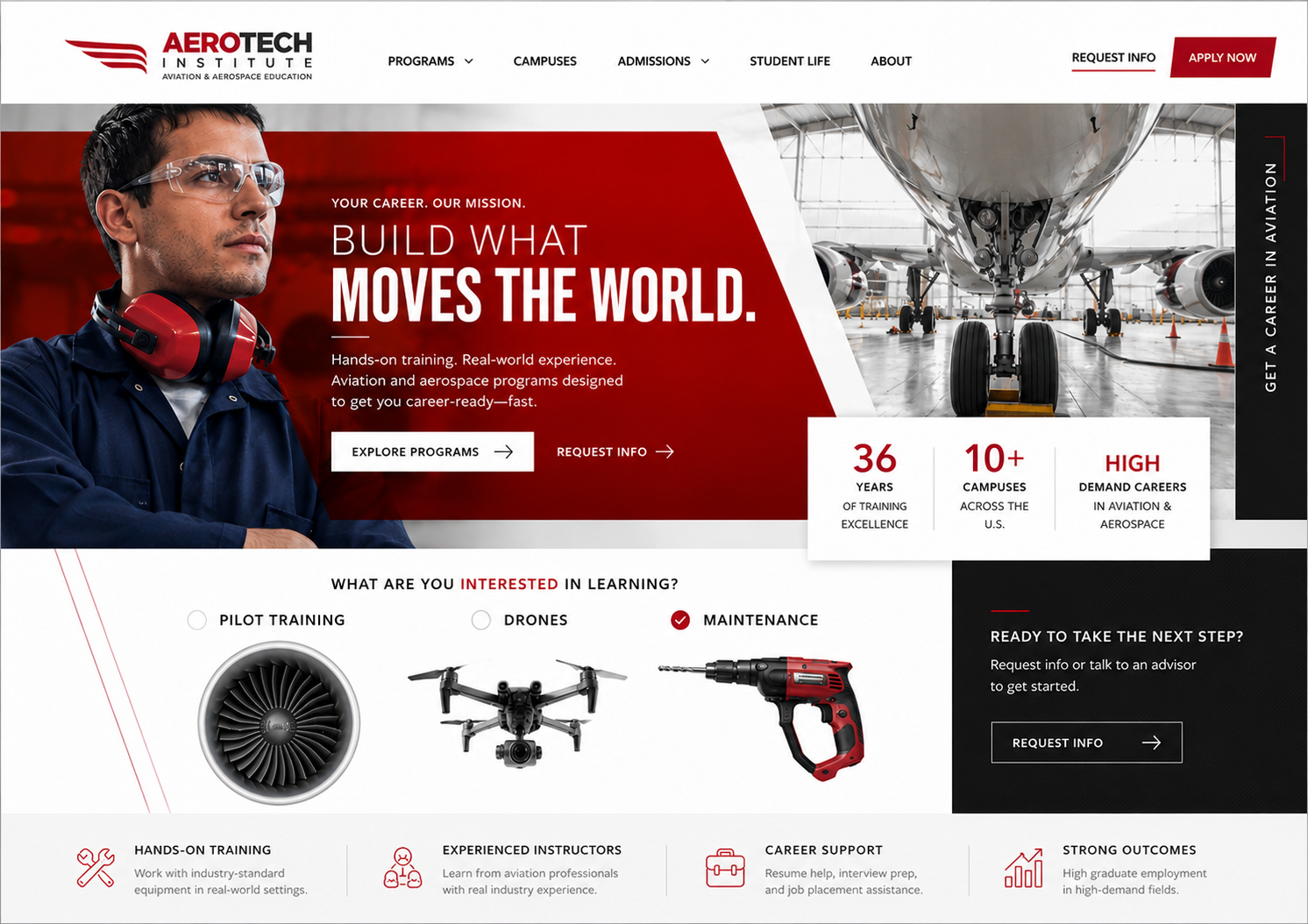
AeroTech Institute operated multiple aviation and aerospace campuses across the central and western U.S., offering programs ranging from pilot training and AMT certifications to avionics and aerospace technology management degrees.
The organization generated consistent lead volume, but enrollment growth and application progression remained inconsistent across programs and regional markets.
Internal teams lacked expertise in:
- Behavioral Segmentation
- Enrollment-focused DX Strategy
- Conversion Optimization
As competition intensified, generalized enrollment marketing was limiting performance across highly different student audiences.
A multi-year DX and CRO initiative was launched to determine whether audience alignment, trust, and personalized enrollment experiences (not demand) were limiting growth.
The Problem
Strong Programs.
Generalized Enrollment Strategy.
Different students were being pushed through the same experience.
The organization treated enrollment as a volume problem.
The data revealed an audience alignment problem.
At a glance, performance appeared stable:
Paid campaigns generated leads.
Traffic remained consistent.
Programs attracted interest.
But enrollment performance told a different story:
Lead quality varied significantly by campus and program.
Messaging failed to reflect regional motivations and career goals.
Prospective students lacked trust in long-term outcomes and value.
What looked like a CRO problem was really a student understanding problem.
Research-Informed Strategy
Research Revealed Enrollment Was a Trust and Relevance Problem
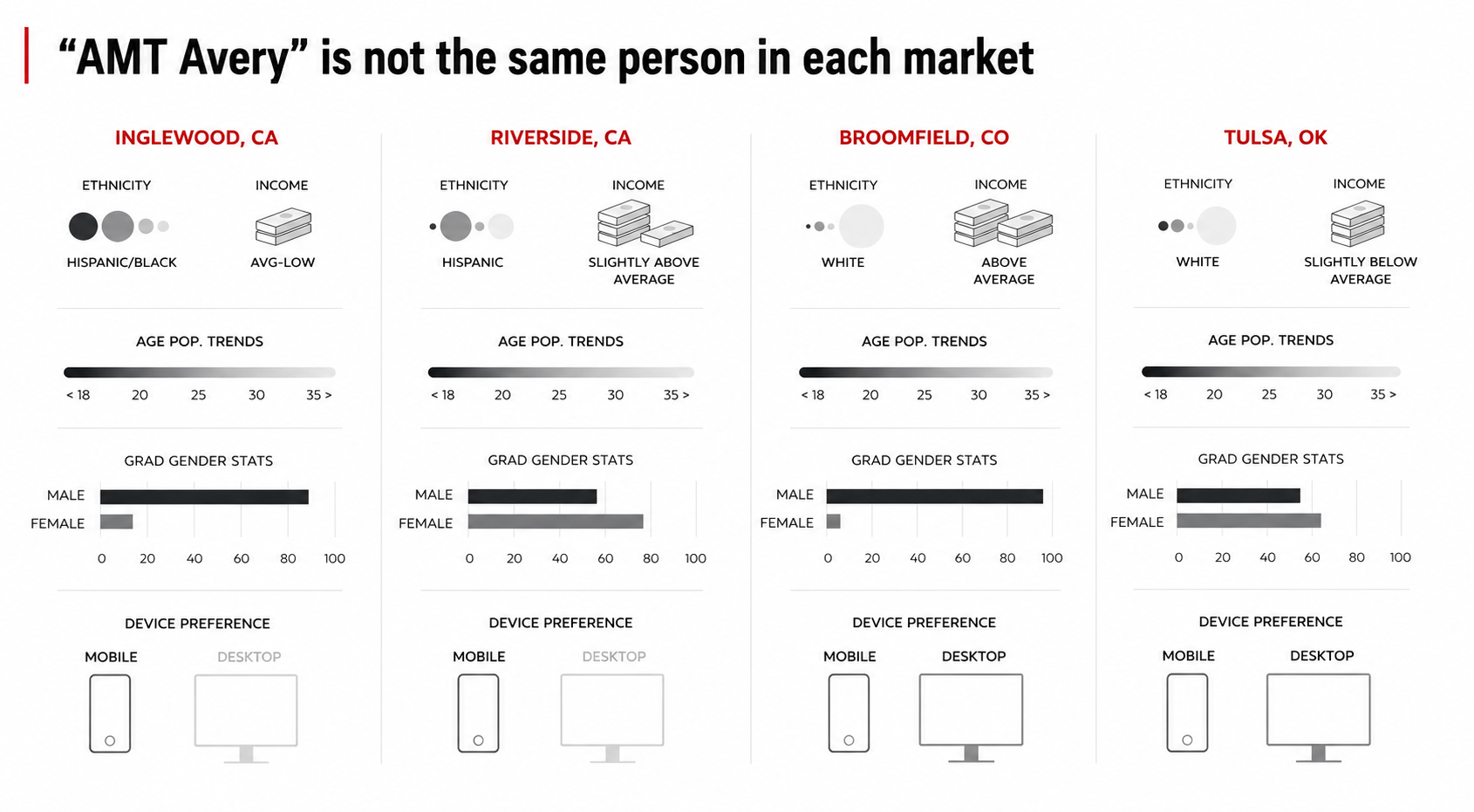
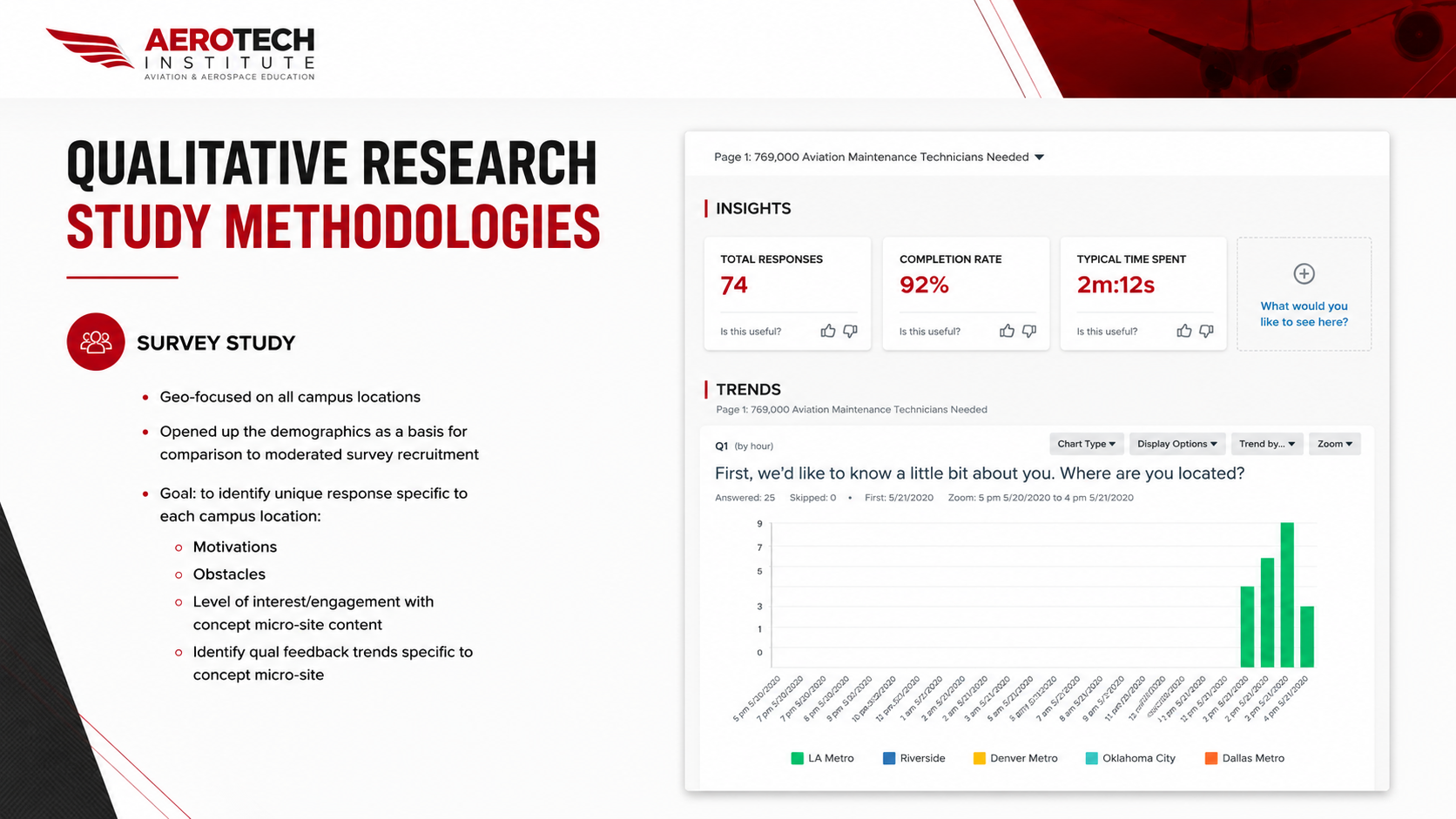
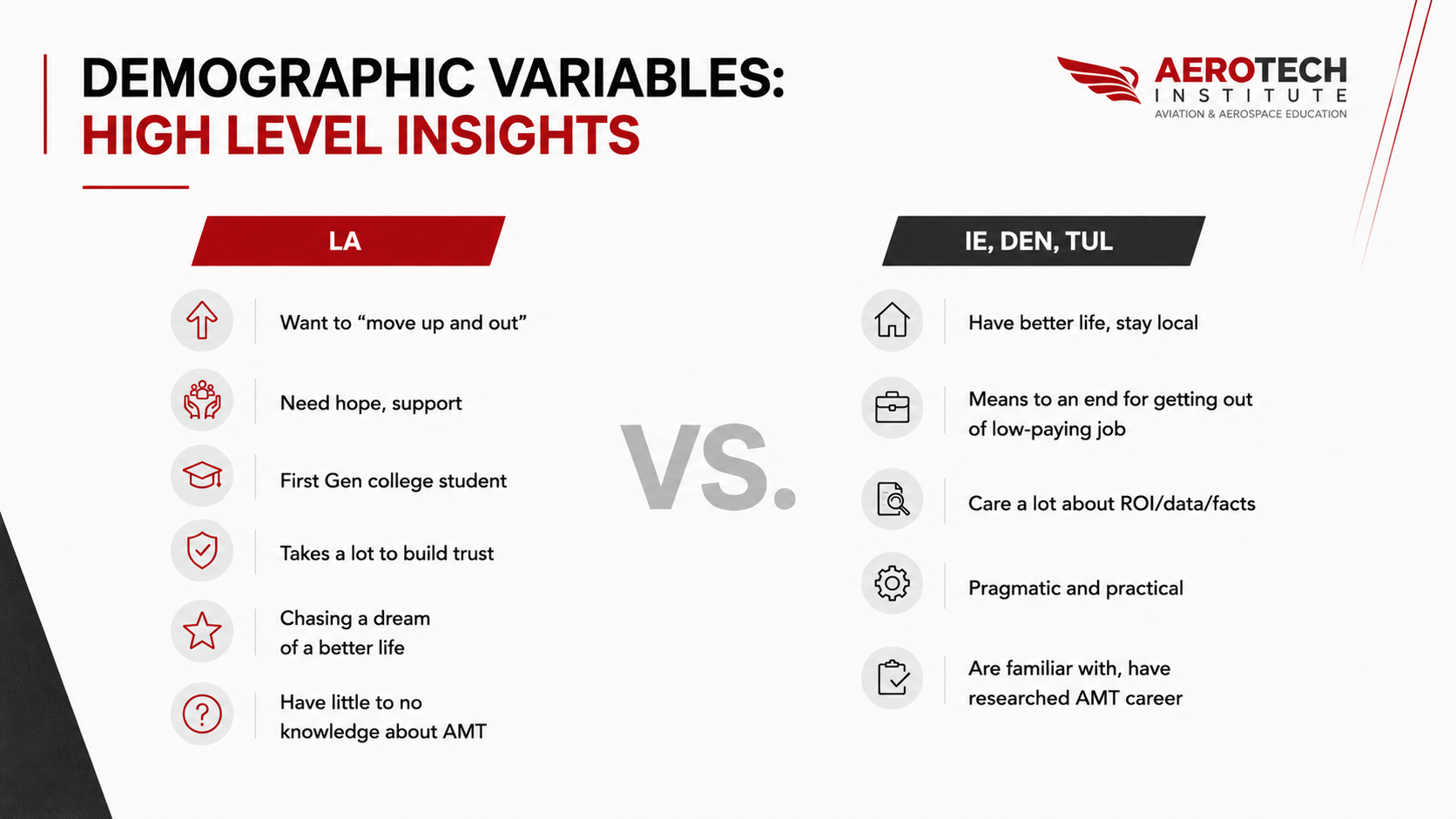
Market research, qualitative studies, survey analysis, and behavioral segmentation revealed that different campuses, programs, and regional audiences were responding to very different motivations, goals, and concerns.
The Enrollment Strategy Changed
Different Audiences Needed Different Reasons To Believe
The strategy shifted from generalized enrollment marketing to audience-specific experiences built around:
- Regional Behavior
- Program Intent
- Career Aspirations
- Trust-driven Messaging
The work included:
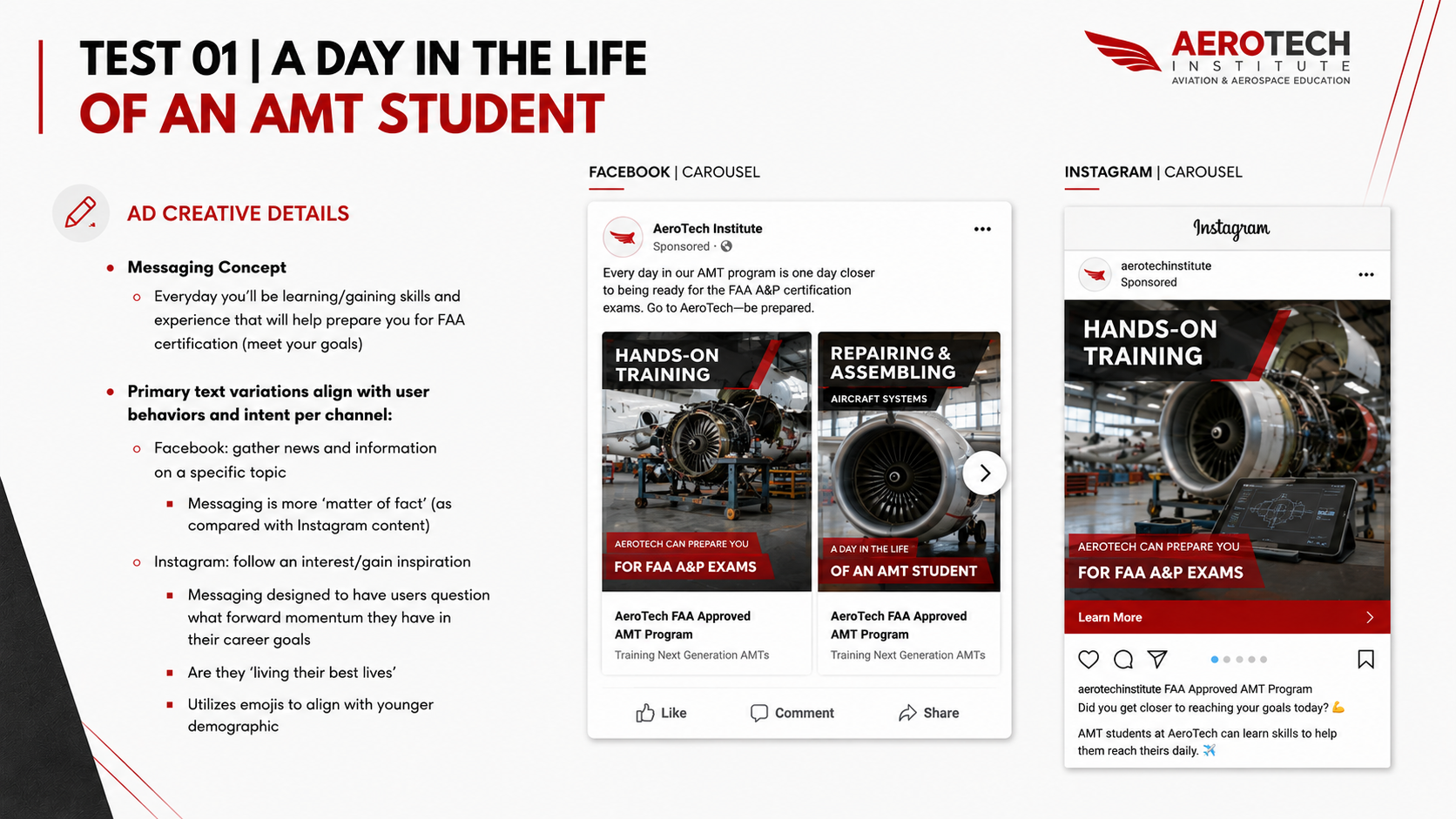
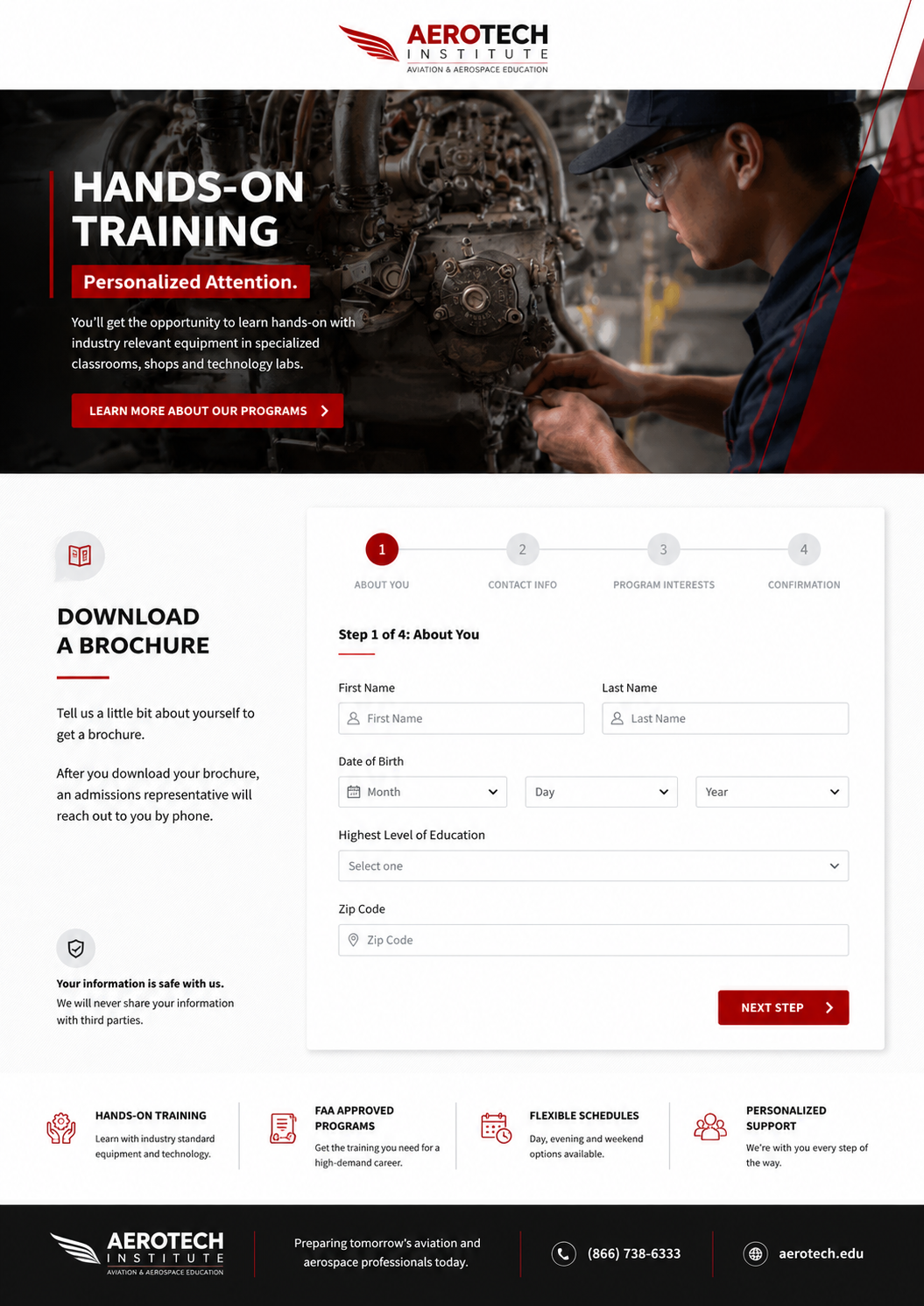
- Geo-targeted Landing Pages
- Program-specific Messaging Systems
- Paid Social Campaigns
- Conversion-focused Enrollment Experiences
Instead of treating enrollment as a lead volume problem, the strategy focused on improving relevance, confidence, and progression across the student decision journey.
The Impact
From Generalized Enrollment Marketing to Audience-Specific Growth
Over a multi-year engagement, enrollment performance improved by aligning acquisition strategy, messaging, and digital experiences to the realities of distinct student audiences, regional markets, and career goals.
Once personalized enrollment strategies were implemented, performance accelerated across multiple campuses and programs:
40%+
Lead CVR Improvement

Program-specific messaging improved lead progression across high-intent audiences.

52%
Increase In Applications


More prospective students moved deeper into the enrollment journey after engaging with personalized enrollment experiences.
68%
Engagement Growth

Audience-specific campaigns generated stronger interaction, engagement, and enrollment intent.

By aligning enrollment strategy to audience behavior, regional realities, and trust-based decision making, the institution improved both lead quality and application progression across highly different student audiences.
Better enrollment performance didn’t come from generating more leads.
It came from understanding who students were, what they needed to believe, and why they hesitated to move forward.
Case Studies
Healthcare SaaS • Research • Retention

Trust in the AI Was Lost at Login
Protecting Clinical Momentum in an AI-Powered EHR
A mixed-method research initiative uncovered how authentication friction reduced confidence in AI-assisted documentation and disrupted critical prescribing workflows →
↑ Workflow Continuity • ↑ Clinician Confidence • ↓ Authentication Friction
Higher Ed • Enrollment Strategy • Acquisition

Enrollment Friction Was Limiting Growth
Students Couldn't Find What They Needed to Believe
Organic traffic had successfully scaled, but lead generation performance had plateaued. Behavioral research uncovered gaps that traditional CRO metrics alone couldn't explain →
↑ Strategic Clarity • ↑ Customer Understanding • ↑ Growth Alignment
Pharma • Product Design • Retention

Improving Adoption Through Behavioral Design
Designing Around the Right Support System Changed Everything
Behavioral research, experience redesign, and coordinated support workflows helped users understand what mattered, what to do next, and when intervention was needed →
↑ Onboarding Completion • ↑ 7-Day Retention • ↓ Response Time
My Expertise Delivers For:
Marketing & Growth
Customer Acquisition & Conversion
Journey Mapping & Funnel Optimization
CRM & Retention Strategy
Behavioral Segmentation & Personalization
Landing Page & Onboarding Optimization
Customer Research & Insight Generation
AI-Supported Content & Experience Strategy
Product & CX
UX & Digital Experience Strategy
Onboarding & Adoption Systems
DAP Strategy & Optimization
Service Blueprinting
Customer & Employee Experience
Behavioral Design & Usability Optimization
AI-supported Product & Support Experiences
Strategy & Transformation
Cross-functional Alignment
Experience Transformation Initiatives
Operational Experience Design
Customer Intelligence Systems
Support and Onboarding Optimization
Research-driven Decision-making
AI-supported Workflow and Systems Strategy
Let’s Build Better Systems for People

© 2026 Beth Pavinich. All rights reserved.
All content, case studies, strategy frameworks, written materials, visuals, diagrams, concepts, and supporting artifacts featured on this site are the intellectual property of Beth Pavinich and may not be copied, reproduced, distributed, modified, adapted, republished, or used in whole or in part without prior written permission.
Many projects featured on this site were completed under non-disclosure agreements (NDAs). Client names and proprietary details have been anonymized. Outcomes reflect engagement-specific performance data, client reporting, benchmark analysis, and directional business impact estimates where exact figures cannot be disclosed.

Growth Improved
When Enrollment
Became More Personal
An audience-specific DX and acquisition strategy transformed generalized enrollment marketing into a behavior-driven growth system for a multi-campus aviation education brand.
ROLE
CRO & Digital Experience Strategy Lead
OWNERSHIP
Behavioral Segmentation, Enrollment Strategy, CRO
///
///
///
Overview
Enrollment Growth Was Slowing. Audience Alignment Wasn’t.
Environment
Multi-Campus Aviation Trade School
Challenge
Low Enrollment Growth & Inconsistent Lead Quality
Objective
Improve Enrollment Performance Through Audience-Specific DX Strategy
AeroTech Institute operated multiple aviation and aerospace campuses across the central and western U.S., offering programs ranging from pilot training and AMT certifications to avionics and aerospace technology management degrees.
The organization generated consistent lead volume, but enrollment growth and application progression remained inconsistent across programs and regional markets.
Internal teams lacked expertise in:
- Behavioral Segmentation
- Enrollment-focused DX Strategy
- Conversion Optimization
As competition intensified, generalized enrollment marketing was limiting performance across highly different student audiences.
A multi-year DX and CRO initiative was launched to determine whether audience alignment, trust, and personalized enrollment experiences (not demand) were limiting growth.
The Problem
Strong Programs.
Generalized Enrollment Strategy.
Different students were being pushed through the same experience.
The organization treated enrollment as a volume problem.
The data revealed an audience alignment problem.
At a glance, performance appeared stable:
Paid campaigns generated leads.
Traffic remained consistent.
Programs attracted interest.
But enrollment performance told a different story:
Lead quality varied significantly by campus and program.
Messaging failed to reflect regional motivations and career goals.
Prospective students lacked trust in long-term outcomes and value.
What looked like a CRO problem was really a student understanding problem.
Research-Informed Strategy
Research Revealed Enrollment Was a Trust and Relevance Problem
Market research, qualitative studies, survey analysis, and behavioral segmentation revealed that different campuses, programs, and regional audiences were responding to very different motivations, goals, and concerns.
The Enrollment Strategy Changed
Different Audiences Needed Different Reasons To Believe
The strategy shifted from generalized enrollment marketing to audience-specific experiences built around:
- Regional Behavior
- Program Intent
- Career Aspirations
- Trust-driven Messaging
The work included:
- Geo-targeted Landing Pages
- Program-specific Messaging Systems
- Paid Social Campaigns
- Conversion-focused Enrollment Experiences
Instead of treating enrollment as a lead volume problem, the strategy focused on improving relevance, confidence, and progression across the student decision journey.
The Impact
From Generalized Enrollment Marketing to Audience-Specific Growth
Over a multi-year engagement, enrollment performance improved by aligning acquisition strategy, messaging, and digital experiences to the realities of distinct student audiences, regional markets, and career goals.
Once personalized enrollment strategies were implemented, performance accelerated across multiple campuses and programs:
40%+
Lead CVR Improvement
Program-specific messaging improved lead progression across high-intent audiences.
52%
Increase In Applications
More prospective students moved deeper into the enrollment journey after engaging with personalized enrollment experiences.
68%
Engagement Growth
Audience-specific campaigns generated stronger interaction, engagement, and enrollment intent.
By aligning enrollment strategy to audience behavior, regional realities, and trust-based decision making, the institution improved both lead quality and application progression across highly different student audiences.
Better enrollment performance didn’t come from generating more leads.
It came from understanding who students were, what they needed to believe, and why they hesitated to move forward.
Case Studies
Trust in the AI Was Lost at Login
Protecting Clinical Momentum in an AI-Powered EHR
A mixed-method research initiative uncovered how authentication friction reduced confidence in AI-assisted documentation and disrupted critical prescribing workflows →
↑ Workflow Continuity • ↑ Clinician Confidence • ↓ Authentication Friction

Healthcare SaaS • Research • Retention
Enrollment Friction Was Limiting Growth
Students Couldn't Find What They Needed to Believe
Organic traffic had successfully scaled, but lead generation performance had plateaued. Behavioral research uncovered gaps that traditional CRO metrics alone couldn't explain →
↑ Strategic Clarity • ↑ Customer Understanding • ↑ Growth Alignment
Higher Ed • Enrollment Strategy • Acquisition
Improving Adoption Through Behavioral Design
Designing Around the Right Support System Changed Everything
Behavioral research, experience redesign, and coordinated support workflows helped users understand what mattered, what to do next, and when intervention was needed →
↑ Onboarding Completion • ↑ 7-Day Retention • ↓ Response Time
Pharma • Product Design • Retention
My Expertise Delivers For:
Marketing & Growth
Customer Acquisition & Conversion
Journey Mapping & Funnel Optimization
CRM & Retention Strategy
Behavioral Segmentation & Personalization
Landing Page & Onboarding Optimization
Customer Research & Insight Generation
AI-Supported Content & Experience Strategy
Product & CX
UX & Digital Experience Strategy
Onboarding & Adoption Systems
DAP Strategy & Optimization
Service Blueprinting
Customer & Employee Experience
Behavioral Design & Usability Optimization
AI-supported Product & Support Experiences
Strategy & Transformation
Cross-functional Alignment
Experience Transformation Initiatives
Operational Experience Design
Customer Intelligence Systems
Support and Onboarding Optimization
Research-driven Decision-making
AI-supported Workflow and Systems Strategy
Let’s Build Better Systems for People
© 2026 Beth Pavinich. All rights reserved.
All content, case studies, strategy frameworks, written materials, visuals, diagrams, concepts, and supporting artifacts featured on this site are the intellectual property of Beth Pavinich and may not be copied, reproduced, distributed, modified, adapted, republished, or used in whole or in part without prior written permission.
Many projects featured on this site were completed under non-disclosure agreements (NDAs). Client names and proprietary details have been anonymized. Outcomes reflect engagement-specific performance data, client reporting, benchmark analysis, and directional business impact estimates where exact figures cannot be disclosed.

Growth Improved
When Enrollment
Became More Personal
An audience-specific DX and acquisition strategy transformed generalized enrollment marketing into a behavior-driven growth system for a multi-campus aviation education brand.
ROLE
CRO & Digital Experience Strategy Lead
OWNERSHIP
Behavioral Segmentation, Enrollment Strategy, CRO
///
///
///
Overview
Enrollment Growth Was Slowing. Audience Alignment Wasn’t.
Environment
Multi-Campus Aviation Trade School
Challenge
Low Enrollment Growth & Inconsistent Lead Quality
Objective
Improve Enrollment Performance Through Audience-Specific DX Strategy
AeroTech Institute operated multiple aviation and aerospace campuses across the central and western U.S., offering programs ranging from pilot training and AMT certifications to avionics and aerospace technology management degrees.
The organization generated consistent lead volume, but enrollment growth and application progression remained inconsistent across programs and regional markets.
Internal teams lacked expertise in:
- Behavioral Segmentation
- Enrollment-focused DX Strategy
- Conversion Optimization
As competition intensified, generalized enrollment marketing was limiting performance across highly different student audiences.
A multi-year DX and CRO initiative was launched to determine whether audience alignment, trust, and personalized enrollment experiences (not demand) were limiting growth.
The Problem
Strong Programs.
Generalized Enrollment Strategy.
Different students were being pushed through the same experience.
The organization treated enrollment as a volume problem.
The data revealed an audience alignment problem.
At a glance, performance appeared stable:
Paid campaigns generated leads.
Traffic remained consistent.
Programs attracted interest.
But enrollment performance told a different story:
Lead quality varied significantly by campus and program.
Messaging failed to reflect regional motivations and career goals.
Prospective students lacked trust in long-term outcomes and value.
What looked like a CRO problem was really a student understanding problem.
Research-Informed Strategy
Research Revealed Enrollment Was a Trust and Relevance Problem
Market research, qualitative studies, survey analysis, and behavioral segmentation revealed that different campuses, programs, and regional audiences were responding to very different motivations, goals, and concerns.
The Enrollment Strategy Changed
Different Audiences Needed Different Reasons To Believe
The strategy shifted from generalized enrollment marketing to audience-specific experiences built around:
- Regional Behavior
- Program Intent
- Career Aspirations
- Trust-driven Messaging
The work included:
- Geo-targeted Landing Pages
- Program-specific Messaging Systems
- Paid Social Campaigns
- Conversion-focused Enrollment Experiences
Instead of treating enrollment as a lead volume problem, the strategy focused on improving relevance, confidence, and progression across the student decision journey.
The Impact
From Generalized Enrollment Marketing to Audience-Specific Growth
Over a multi-year engagement, enrollment performance improved by aligning acquisition strategy, messaging, and digital experiences to the realities of distinct student audiences, regional markets, and career goals.
Once personalized enrollment strategies were implemented, performance accelerated across multiple campuses and programs:
40%+
Lead CVR Improvement
Program-specific messaging improved lead progression across high-intent audiences.
52%
Increase In Applications
More prospective students moved deeper into the enrollment journey after engaging with personalized enrollment experiences.
68%
Engagement Growth
Audience-specific campaigns generated stronger interaction, engagement, and enrollment intent.
By aligning enrollment strategy to audience behavior, regional realities, and trust-based decision making, the institution improved both lead quality and application progression across highly different student audiences.
Better enrollment performance didn’t come from generating more leads.
It came from understanding who students were, what they needed to believe, and why they hesitated to move forward.
Case Studies
Healthcare SaaS • Research • Retention
Trust in the AI Was Lost at Login
Protecting Clinical Momentum in an AI-Powered EHR
A mixed-method research initiative uncovered how authentication friction reduced confidence in AI-assisted documentation and disrupted critical prescribing workflows →
↑ Workflow Continuity • ↑ Clinician Confidence •
↓ Authentication Friction
Higher Ed • Enrollment Strategy • Acquisition
Enrollment Friction Was Limiting Growth
Students Couldn't Find What They Needed to Believe
Organic traffic had successfully scaled, but lead generation performance had plateaued. Behavioral research uncovered gaps that traditional CRO metrics alone couldn't explain →
↑ Strategic Clarity • ↑ Customer Understanding •
↑ Growth Alignment
Pharma • Product Design • Retention
Improving Adoption Through Behavioral Design
Designing Around the Right Support System Changed Everything
Behavioral research, experience redesign, and coordinated support workflows helped users understand what mattered, what to do next, and when intervention was needed →
↑ Onboarding Completion • ↑ 7-Day Retention •
↓ Response Time
My Expertise Delivers For:
Marketing & Growth
Customer Acquisition & Conversion
Journey Mapping & Funnel Optimization
CRM & Retention Strategy
Behavioral Segmentation & Personalization
Landing Page & Onboarding Optimization
Customer Research & Insight Generation
AI-Supported Content & Experience Strategy
Product & CX
UX & Digital Experience Strategy
Onboarding & Adoption Systems
DAP Strategy & Optimization
Service Blueprinting
Customer & Employee Experience
Behavioral Design & Usability Optimization
AI-supported Product & Support Experiences
Strategy & Transformation
Cross-functional Alignment
Experience Transformation Initiatives
Operational Experience Design
Customer Intelligence Systems
Support and Onboarding Optimization
Research-driven Decision-making
AI-supported Workflow and Systems Strategy
Let’s Build Better Systems for People
© 2026 Beth Pavinich. All rights reserved.
All content, case studies, strategy frameworks, written materials, visuals, diagrams, concepts, and supporting artifacts featured on this site are the intellectual property of Beth Pavinich and may not be copied, reproduced, distributed, modified, adapted, republished, or used in whole or in part without prior written permission.
Many projects featured on this site were completed under non-disclosure agreements (NDAs). Client names and proprietary details have been anonymized. Outcomes reflect engagement-specific performance data, client reporting, benchmark analysis, and directional business impact estimates where exact figures cannot be disclosed.